
Snapshot
- Role: Owner-operator (Web Strategy, Technical SEO, Content Ops)
- Type: Owned media site (content platform)
- Primary outcomes: Discoverability, engagement, scalable publishing system
- Results: 11,000+ monthly active users and 50k+ monthly engagement events (site analytics)
Role tracks
- Primary: Web Strategy and Growth
- Secondary: Digital Adoption and Enablement (content governance, measurement loops)
- Also relevant to: Learning Tech (engagement measurement, content-as-learning paths)
Context
ysamphy.com is an owned content site focused on personal productivity and business growth. The goal was to move beyond “publishing more” and instead build a system where content is easy to discover, easy to navigate, and easy to maintain over time.
The problem
Growth becomes inconsistent when:
- topics are not organized into clusters (content competes with itself)
- internal links are ad hoc, not a navigational system
- structured data is missing or inconsistent
- older posts are not refreshed, consolidated, or redirected
- measurement is incomplete, so prioritization is guesswork
Goals
- Improve organic discoverability with technical SEO and clearer content architecture
- Increase engagement through stronger internal navigation and content paths
- Build a repeatable content-ops system that scales without chaos
- Create a measurement loop for continuous iteration
Constraints
- Solo execution across strategy, implementation, and publishing
- Prioritize durability and “clean” practices over risky SEO shortcuts
- Keep the system lightweight enough to maintain consistently
What I did
1) Technical baseline and prioritized backlog
- Audited crawl/indexing signals, template consistency, duplicates, and thin content patterns
- Converted findings into a prioritized backlog with a clear “definition of done.”
2) Topic clusters and information architecture
- Defined core topics and mapped supporting posts into clusters
- Established rules for where a post belongs and how it connects to hub pages
3) Internal linking system (rules, not vibes)
- Standardized linking patterns: hub-to-supporting, supporting-to-hub, and selective cross-links
- Built a quick checklist for publishing and updating so internal linking stays consistent
4) Structured data (schema) plan
- Implemented a simple schema decision framework by content type
- Focused on clarity, consistency, and long-term maintainability
5) Content operations and governance
- Created content templates and publishing QA steps
- Set an update cadence for high-potential posts and consolidation rules for overlap
6) Measurement and iteration
- Defined “meaningful engagement” events and success metrics by topic cluster
- Added a monthly review routine: what improved, what declined, what to fix next
Deliverables
- Technical SEO audit and prioritized roadmap
- Topic cluster map and content architecture rules
- Internal linking SOP + checklist
- Schema decision guide by content type
- Content ops playbook (templates, standards, update cadence)
- Measurement plan and iteration workflow
Results
- 11,000+ monthly active users
- 50,000+ monthly engagement events
- Faster prioritization (clear backlog tied to measurable signals)
- A repeatable system that reduces overhead as the content library grows
Proof
Below is a GA4 snapshot (Jan 1–31, 2026) showing traffic and engagement for ysamphy.com. Screenshots are sanitized and shared at a high level. Additional documentation is available on request.
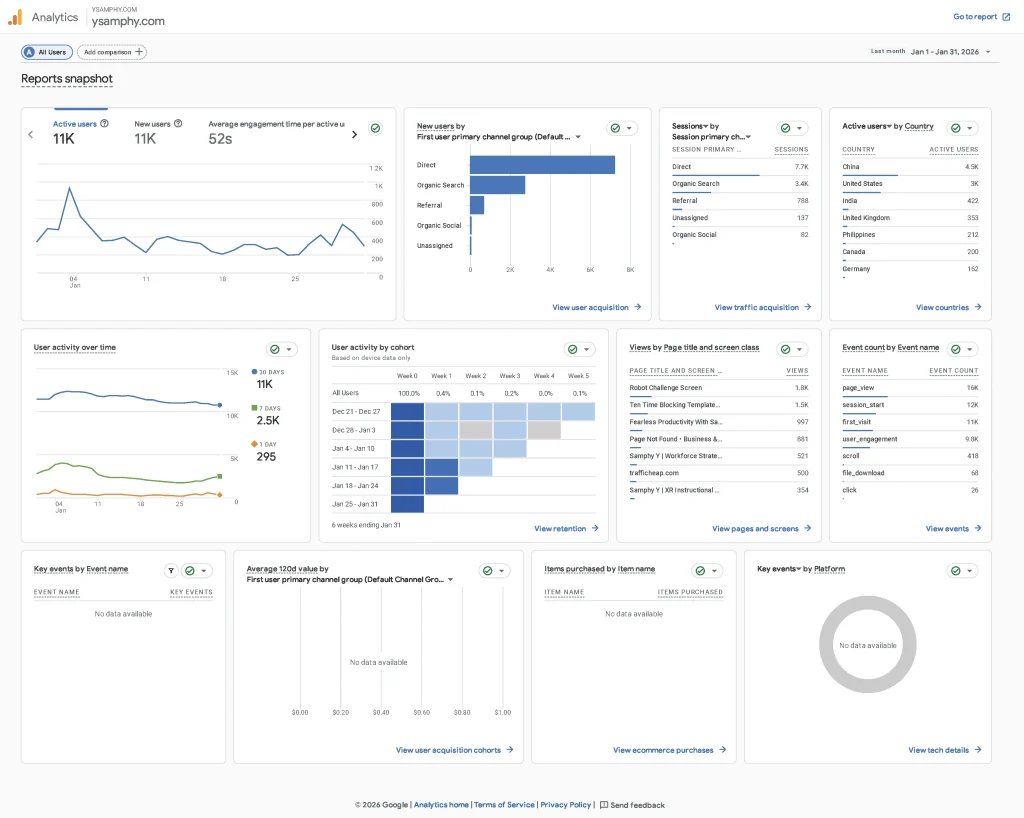
GA4 Reports snapshot (Jan 2026)
Selected highlights from this snapshot:
- Active users: 11K
- New users: 11K
- Avg engagement time (per active user): 52s
- Sessions by channel: Direct 7.7K, Organic Search 3.4K, Referral 788
Downloadable proof pack – Media Growth via Technical SEO and Content Operations
Downloadable proof pack – Web and SEO audit work sample
More available on request
Full audit notes, detailed backlog, and deeper dashboards can be shared upon request.
Confidentiality note: Client and project details are summarized at a high level. Deeper documentation is available on request.
What I’d do next in the first 30–90 days (in a Web Strategy role)
- Expand cluster coverage with gap analysis and consolidation
- Strengthen conversion paths tied to top-performing clusters
- Formalize performance hygiene checks at the template level
- Operationalize a content refresh pipeline alongside new publishing
Skills Demonstrated
Technical SEO, content architecture, topic clusters, internal linking, schema markup, content operations, governance, measurement plan, dashboards, continuous improvement.