
Overview
Education programs do not succeed only because the product is useful. They succeed when administrators, teachers, and learners understand what to do next, why it matters, and how the program fits into their existing responsibilities.
This public-safe writing sample demonstrates how I approach lifecycle engagement communications for education programs. It includes representative examples of onboarding, activation, engagement, renewal, expansion, newsletter, and short campaign touchpoints designed for a school, district, or education partner audience.
The sample is not based on confidential client material. It is adapted from my broader experience in education engagement, CRM follow-up, onboarding communications, digital adoption, and learning program implementation.
The Challenge
Education leaders and teachers are busy. Even when they believe in a program, adoption can slow down after launch because communication is scattered, next steps are unclear, or follow-up messages do not reflect the realities of the classroom.
Common lifecycle challenges include:
- Administrators need a clear implementation path, not just a product announcement.
- Teachers need practical first steps that feel manageable.
- Program teams need engagement signals to understand where adoption is strong or weak.
- Renewal and expansion conversations need to be tied to evidence, outcomes, and partner goals.
- Communications must be clear, respectful, and useful without adding noise.
For education programs, good lifecycle messaging must do more than “promote.” It must reduce friction, build trust, and help the audience take the next useful action.
Audience
The representative audience for this sample includes:
- School and district administrators
- Instructional leaders
- Instructional technology leaders
- Teachers and program champions
- Customer success, services, or partner teams supporting education adoption
The tone is intentionally practical, warm, and action-oriented. The goal is to respect the pressure educators face while still guiding them toward meaningful engagement.
Goal
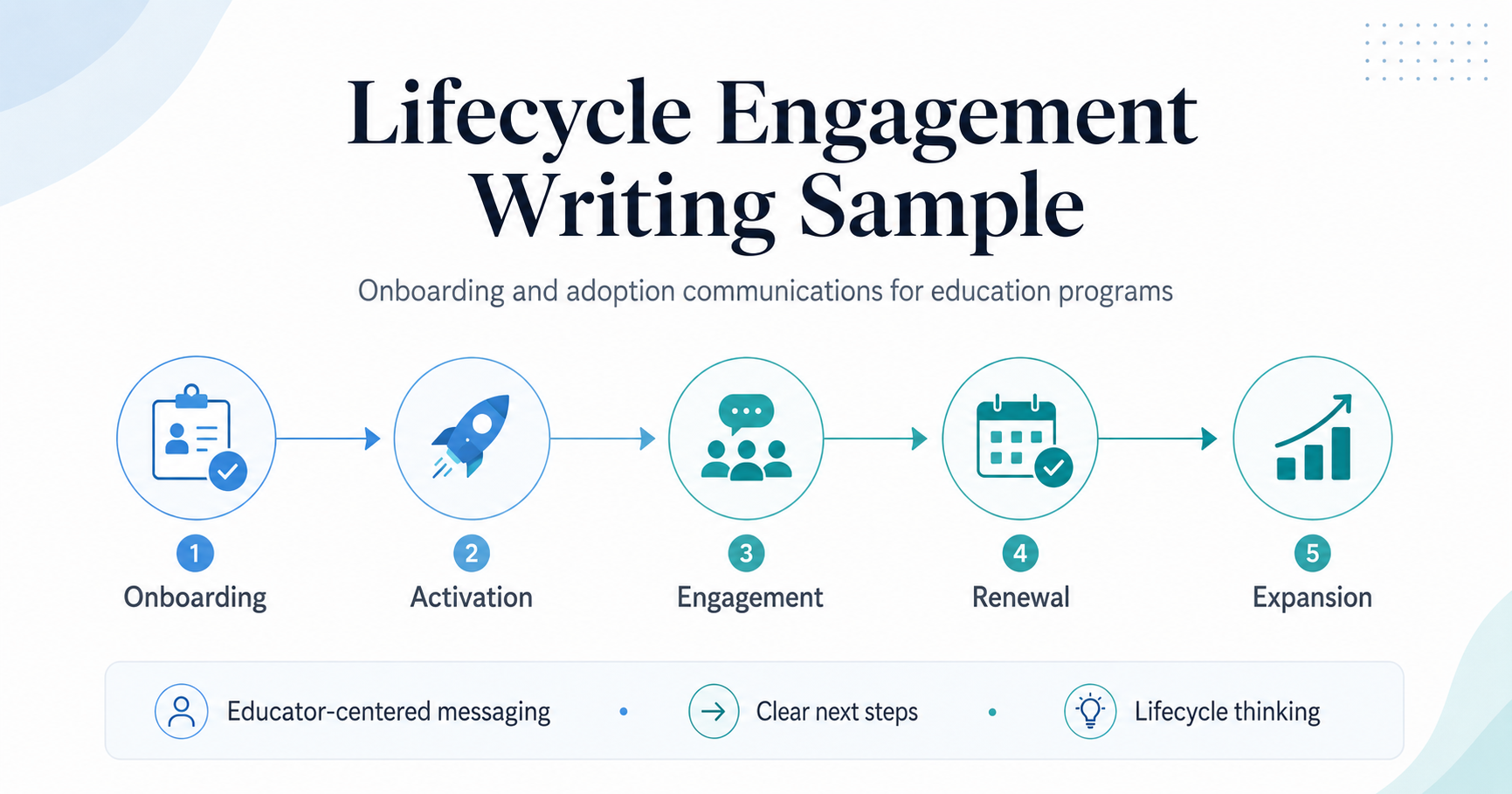
The goal of this sample is to show how lifecycle communications can support the full customer journey:
- Onboarding — Help a new school or district partner understand what happens next.
- Activation — Encourage the first meaningful action from administrators or teachers.
- Engagement — Reinforce usage, share best practices, and respond to adoption signals.
- Renewal — Connect program activity to outcomes and partner priorities.
- Expansion — Identify opportunities to deepen use across additional classrooms, grades, or teams.
- Measurement — Use engagement data to improve messaging over time.
Each message is designed around one simple principle: make the next step clear.
Approach
My approach combines lifecycle marketing, learning design, and digital adoption thinking.
Instead of treating communications as one-time announcements, I design them as a sequence of timely touchpoints. Each touchpoint should answer three questions for the audience:
- Why does this matter?
- What should I do next?
- Where can I get support?
For an education audience, I also pay attention to timing and emotional load. A message sent during launch week should not sound like a sales pitch. It should sound like a helpful guide. A renewal message should not only ask for continuation; it should summarize value, surface evidence, and invite a focused conversation about what comes next.
The sample includes several formats because lifecycle engagement rarely happens in one channel. A complete program may include emails, newsletters, in-product prompts, partner enablement notes, webinar follow-ups, and short internal messages for sales or services teams.
Sample Assets Included
The attached writing sample includes representative content for:
- Welcome and onboarding email
- Teacher activation message
- Engagement check-in
- Renewal or expansion touchpoint
- Newsletter-style update
- Short in-product or campaign message
- Measurement and learning notes
These examples are written to demonstrate clarity, audience empathy, conversion-oriented structure, and cross-functional usefulness.
What This Demonstrates
This sample demonstrates my ability to:
- Write clear lifecycle and customer engagement content for education audiences
- Translate program goals into practical user-facing messaging
- Support onboarding, adoption, engagement, renewal, and expansion
- Use plain language while preserving strategic intent
- Connect communications to measurable behaviors and follow-up actions
- Build messages that can support marketing, sales, services, and customer success teams
- Adapt tone for administrators, teachers, and internal stakeholders
It also reflects my broader work across learning technology, digital adoption, and strategic communications. I have supported education and workforce learning programs, built onboarding and enablement materials, helped grow an EdTech learner base through CRM follow-up and engagement workflows, and translated complex program goals into practical guidance for non-technical users.
Results and Learning
Because this is a public-safe representative sample, it does not claim private campaign results. However, it reflects lessons from my applied work in education engagement, digital adoption, and learning communications.
The key learning is that lifecycle content performs best when it is not written only as marketing copy. It should function as guidance. Strong lifecycle content helps the audience feel oriented, supported, and confident enough to take the next step.
For education programs, the most effective messages tend to:
- Lead with the learner or educator benefit
- Keep the action small and specific
- Use plain language instead of internal jargon
- Respect the time pressure of school teams
- Connect program activity to meaningful outcomes
- Give partner-facing teams reusable language for follow-up
- Use engagement signals to adjust the next message
In practice, lifecycle messaging becomes a bridge between strategy and adoption. It helps ensure that a program is not only launched, but actually used.
Download the Writing Sample
Download the full public-safe writing sample here:
Related Capabilities
This sample connects to my work in:
- Learner engagement strategy
- Customer lifecycle communications
- Education technology adoption
- CRM follow-up and audience segmentation
- Onboarding and enablement content
- LMS and learning program implementation
- Web, SEO, and content operations
- Digital adoption and change communications