
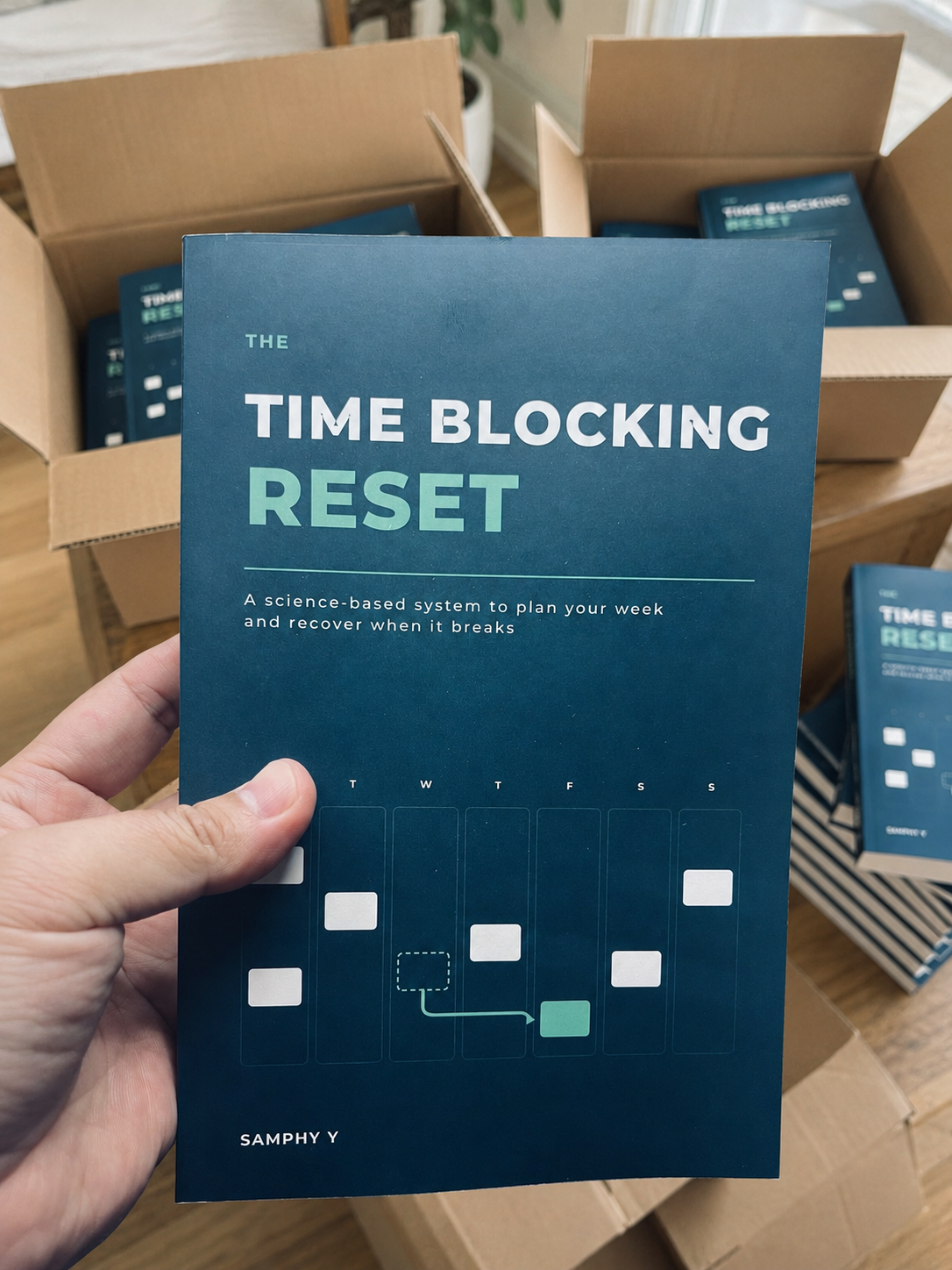
Snapshot
- Project: The Time Blocking Reset: A science-based system to plan your week and recover when it breaks
- Role: Author, researcher, editorial lead, and publishing project owner
- Audience: Knowledge workers, entrepreneurs, consultants, creators, parents, caregivers, students, and other people whose weeks rarely follow the original plan
- Final manuscript: 16 chapters across 210 print pages
- Formats: Kindle, paperback, and hardcover
- Publishing platform: Amazon Kindle Direct Publishing
- Final production package: Version 36
- Companion experience: Reset Engine
- Status: Published in 2026
Project Disclosure
This was an independently developed book project. I wrote, researched, revised, and directed the book from concept through publication.
ChatGPT was part of the editorial workflow. I used it to question ideas, explore structures, develop and compare drafts, identify gaps, improve clarity, and support repeated revision. Some passages began with AI-generated drafts and were then extensively edited. I remained responsible for the argument, source selection, personal experience, editorial judgment, final wording, and published work.
The cover artwork also used AI generation followed by extensive customization. These uses were disclosed to Amazon KDP according to its publishing requirements.
Context: A Book That Remained a “Someday” Project
I have been writing online since 2007 and had imagined publishing books for years. Yet the book remained a “someday” project.
Work, family, study, consulting, business responsibilities, and more urgent priorities repeatedly came first. The desire to write a book did not disappear, but desire alone did not produce a manuscript.
The eventual project grew from a subject I had explored repeatedly in my writing and in my own life: how to plan meaningful work inside weeks that rarely behave.
At different times, my weeks have included consulting, training, legal work, digital strategy, graduate study, emerging-media projects, writing, family responsibilities, and business administration. A conventional calendar could show the available hours, but it could not always represent the mental cost of moving among those roles.
That tension became the foundation of the book.
The Problem I Wanted the Book to Solve
Most time-blocking advice concentrates on constructing a schedule. It tells readers to identify priorities, place tasks on a calendar, and protect the resulting blocks.
That advice can help, but it leaves a practical question unanswered: what should someone do when the schedule no longer matches reality?
Meetings run long. Tasks expand. Priorities change. Energy drops. Family needs attention. An interruption can rearrange the entire day. By Wednesday, a reasonable plan made on Monday may describe a week that no longer exists.
The problem was not simply how to plan a better week. It was how to build a planning system with a return path.
The central thesis became:
The week will break. The system is the return path.
Project Goals
I set five goals for the book:
- Explain why otherwise reasonable weekly plans break.
- Connect time blocking to research on attention, cognitive load, task switching, unfinished work, implementation intentions, and planning bias.
- Translate that research into a practical system readers could adapt to different kinds of work and life.
- Treat disruption as a design condition rather than evidence of personal failure.
- Produce a finished book that worked across Kindle, paperback, and hardcover formats.
The book could not be a collection of loosely connected productivity tips. It needed a coherent argument, a usable method, concrete exercises, and enough flexibility to serve readers with different responsibilities.
The Editorial and Production Constraints
Several constraints shaped the project.
The science had to remain readable
The subtitle makes a clear promise: a science-based system. That required more than adding research language to familiar advice.
The manuscript needed to explain mechanisms accurately while remaining useful to a general reader. The final production package retained 130 source-note pairs and 64 DOI links, with chapter-grouped notes and a full references section. Those sources had to support the reasoning without turning the main chapters into an academic paper.
The system had to work after disruption
A rigid system would contradict the book’s premise. Every framework had to be tested against imperfect conditions: limited attention, changing energy, unfinished commitments, family obligations, interruptions, and weeks with more demands than capacity.
AI had to support judgment rather than replace it
Using ChatGPT accelerated exploration and revision, but speed was not the only objective. The workflow needed to preserve accuracy, coherence, voice, and responsibility.
AI output could propose language or structure. It could not decide what I believed, verify an experience it had not lived, or accept responsibility for the finished book.
One manuscript had to become three products
Kindle, paperback, and hardcover editions share a book, but they are not identical production files. Each format introduced different requirements for navigation, page geometry, cover dimensions, links, typography, and quality assurance.
Finishing the prose was therefore only one stage of finishing the project.
How I Developed the Book
1. I defined the promise before expanding the manuscript
The book needed a promise that was narrower and more useful than “be more productive.”
That promise became: build a credible weekly plan, protect the attention your priorities require, and recover when the original schedule stops fitting reality.
Defining the promise helped determine what belonged in the manuscript and what did not. Advice that encouraged readers to pack more into the calendar without addressing capacity, energy, or recovery did not serve the book.
2. I built the argument in three parts
The final manuscript contains 16 chapters organized into three parts.
Part I: The Science of a Broken Week examines why plans fail. It covers the planning fallacy, cognitive load, task switching, open loops, attention, situated action, and the difference between time blocking and time boxing.
Part II: The Time Blocking Reset System develops the practical method. It introduces the Weekly Reset, four block types, the Recovery Block, energy-aware planning, daily re-entry, the Broken Week Protocol, and a capture-to-calendar pipeline.
Part III: Applied Time Blocking adapts the system for entrepreneurs, consultants, operators, creators, writers, knowledge workers, parents, caregivers, students, and lifelong learners. It concludes with a seven-day reset readers can follow.
This structure moves from diagnosis to system design and then to application. Readers first understand why a week breaks, then learn the method, and finally adapt it to their own context.
3. I combined research with lived constraints
Research helped explain the cognitive and behavioral mechanisms behind the system. Personal and professional experience helped test whether those mechanisms were being translated into a believable week.
For example, the book discusses attention residue and switching costs, but it also connects them to the practical experience of moving between writing, client work, family logistics, administration, graduate study, and technical projects.
The aim was not to present personal experience as scientific proof. It was to use research to explain patterns and experience to make their practical consequences visible.
4. I used ChatGPT inside a governed editorial workflow
ChatGPT supported several kinds of work:
- testing whether the central argument remained coherent;
- exploring alternative outlines and section structures;
- generating draft language for selected passages;
- identifying repetition, missing transitions, and weak explanations;
- comparing versions of headings, examples, exercises, and summaries;
- checking terminology and cross-chapter consistency;
- supporting metadata, production documentation, and launch preparation.
I did not treat the first output as finished prose. AI-generated material became editorial input that could be accepted, rejected, combined, sourced, rewritten, or removed.
The human work included deciding what the book should argue, selecting and checking sources, contributing the personal and professional context, judging whether advice was responsible, revising the prose, and approving every published element.
This made the project a practical exercise in human-AI collaboration. AI increased the number of options I could examine. Human judgment determined which options belonged in the book.
5. I revised until the book worked as a system
The final production package reached version 36. The version number reflects the iterative nature of the work across manuscript development, source notes, exercises, companion resources, formatting, metadata, and production quality assurance.
Revision was not limited to polishing sentences. It included questions such as:
- Does each chapter advance the central promise?
- Are the frameworks distinct enough to be remembered and used?
- Does the science support the recommendation being made?
- Is the advice realistic for someone with limited capacity?
- Does a later chapter contradict an earlier one?
- Can a reader recover without rebuilding the entire calendar?
- Are exercises specific enough to produce an action rather than another intention?
The final book includes practical tools such as the Weekly Reset, Four-Block Map, Energy Map, Broken Week Protocol, Daily Re-entry, and 7-Day Time Blocking Reset.
6. I treated production as part of authorship
Once the manuscript was stable, the project moved into production.
The paperback interior was formatted at 6 × 9 inches and finalized at 210 pages. The print package required embedded fonts, stable pagination, correct margins, a full wraparound cover, and a spine calculated for the final page count and cream paper.
The Kindle edition required a separate EPUB workflow with working navigation and links. The verified EPUB contained 29 navigation entries, 291 internal links, and 67 external links. The cover was prepared separately for digital display.
The hardcover reused the visual identity but required its own case-laminate cover geometry, including a different spine, hinges, and wrap areas.
Each format went through its own preview and quality-control process before publication.
Key Editorial Decisions
Plan from capacity, not fantasy
The book rejects the fantasy week in which every task starts on time, every interruption can be ignored, and energy remains constant. Planning begins with actual obligations, usable attention, predictable risks, and recovery space.
Protect attention before filling time
A two-hour block is not automatically useful. The system asks what kind of attention the work requires and what transition costs must be paid before that attention becomes available.
Design recovery before the week breaks
Recovery is not an emergency patch. It is part of the system. The Recovery Block, Daily Re-entry, and Broken Week Protocol give readers ways to move, shorten, split, release, or resume work intentionally.
Make the next action visible
Vague calendar labels preserve uncertainty. The book repeatedly translates broad intentions into actions with a recognizable situation, output, and stopping point.
Keep human judgment in control of AI
The same principle applies to the editorial workflow and the planning methods inside the book. AI can expose options, reveal trade-offs, and accelerate iteration. It should not decide what a book means or what a person’s week is for.
Deliverables
The completed project produced:
- a 16-chapter nonfiction manuscript;
- a 210-page, 6 × 9-inch print interior;
- a validated Kindle EPUB;
- separate Kindle, paperback, and hardcover cover assets;
- Kindle, paperback, and hardcover editions on Amazon;
- 130 source-note pairs and 64 DOI links;
- reader exercises and applied planning frameworks;
- a Companion Resources section;
- integration with the Reset Engine;
- production handoff, metadata, disclosure, and quality-assurance documentation.
Outcomes to Date
The most important verified outcome is completion.
The project moved from a long-postponed ambition to a published intellectual product available in three formats. The first paperback author copies have been received, and hardcover author copies have been ordered.
The book also created a durable center for a broader body of work around realistic weekly planning. It connects the research-aware framework in the book with practical resources on ysamphy.com, the free 7-Day Time Blocking Reset, Time Blocking OS, and the developing Reset Engine app.
Commercial results are not reported here yet. Sales, Kindle Unlimited reading, reviews, and reader feedback need time to accumulate before they can support a responsible outcome claim. This case study can be updated when that evidence exists.
Skills Demonstrated
- Long-form content strategy
- Research synthesis and source management
- Developmental editing and structural revision
- Human-AI editorial workflow design
- Instructional explanation and exercise design
- Audience positioning and product messaging
- Multi-format publishing production
- Metadata and launch preparation
- Quality assurance across digital and print outputs
- End-to-end project ownership
What I Learned
A book is not finished when the draft is finished
The final stages required as much discipline as the early writing: citations, cross-references, navigation, layout, cover geometry, metadata, previewing, disclosure, pricing decisions, and physical inspection.
AI is most useful inside a clear decision system
ChatGPT made exploration and iteration faster. Its value increased when the task, constraints, evidence standard, and decision owner were explicit.
Evidence and accessibility can coexist
A science-based book does not need to read like a journal article. Research can remain traceable while the main prose stays direct, practical, and humane.
Completion requires reducing optionality
At some point, the project needed decisions rather than more possibilities: one subtitle, one structure, one production master, one cover system, and a defined release path.
The return path applies to creative work too
The process of writing the book reflected its thesis. Progress did not depend on an uninterrupted perfect schedule. It depended on being able to return to the manuscript, recover context, make the next decision, and continue.
Why This Project Matters to My Work
The Time Blocking Reset demonstrates how I connect research, systems thinking, learning design, responsible AI use, content strategy, and hands-on production.
The project required both abstraction and execution. I had to define a problem, build a coherent framework, translate evidence, design a reader journey, govern an AI-assisted workflow, manage revisions, produce usable assets, and carry the work through publication.
Those same capabilities apply beyond books. They are relevant wherever complex knowledge must become a clear, credible, and usable experience.
Next Phase
The next phase is evidence-led rather than expansion for its own sake:
- gather verified reader feedback and reviews;
- monitor sales and Kindle Unlimited activity;
- identify questions or exercises that readers find most useful;
- improve companion resources where evidence supports a change;
- continue developing the Reset Engine as a practical planning and recovery tool;
- document commercial outcomes only after enough data exists.
View the Finished Book
The Time Blocking Reset is available on Amazon in Kindle, paperback, and hardcover editions.
View The Time Blocking Reset on Amazon
The week will break. The system is the return path.