
Real estate auctions can be both exciting and intimidating. The prospect of acquiring a property at a competitive price, often below market value, appeals to many investors, but the process comes with unique challenges. Unlike traditional property sales, auctions operate on compressed timelines and require buyers to act decisively. Many investors step into these fast-paced scenarios unprepared, and the most common misstep is misunderstanding how hard money financing options work in this environment.
Why Auctions Are Different From Traditional Real Estate Deals
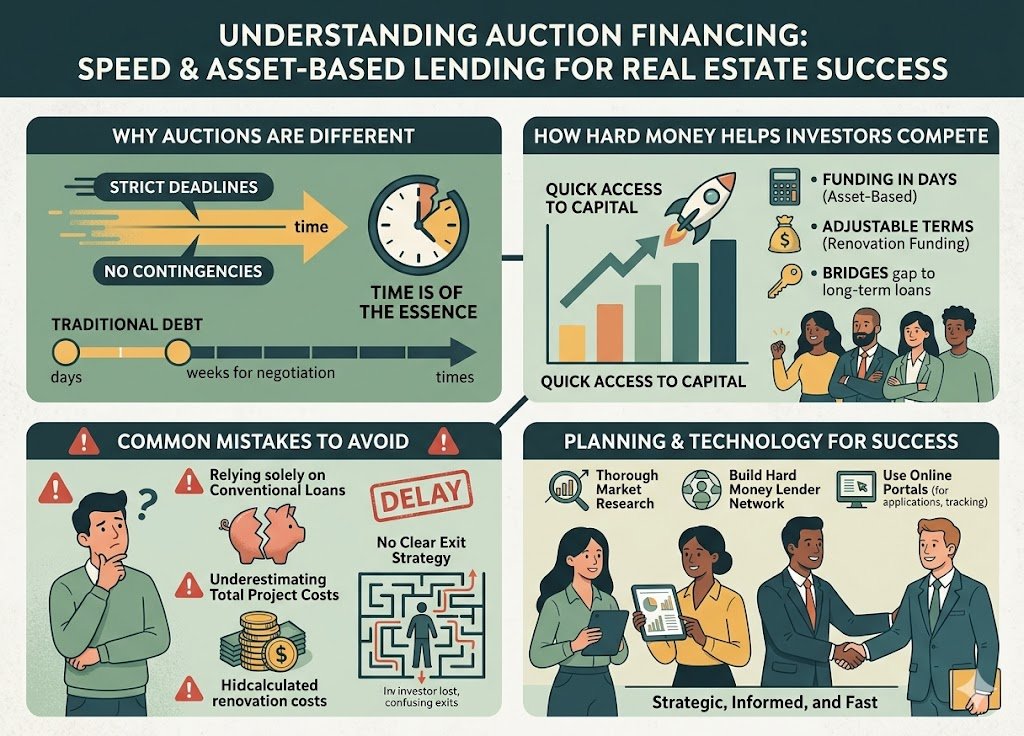
In a number of ways, auctions differ significantly from regular real estate sales. Buyers typically have weeks or even months to negotiate terms, obtain financing, and carry out inspections in a typical transaction. In contrast, auctions have stringent deadlines. Many times, properties are sold “as-is,” which eliminates the possibility of long-term contingencies. The closing period is frequently far shorter than in traditional sales, and buyers are usually required to present proof of funds or acquire financing prior to putting a bid.
For investors who only rely on conventional bank loans, this faster pace reveals a significant vulnerability. Credit checks, income verification, underwriting, and appraisal scheduling are all part of the drawn-out mortgage approval process. These delays can be lethal in situations involving competitive auctions. If an investor hasn’t set up alternative finance in advance, they can watch as a home they’ve looked at and desired gets sold to someone who has the money right away.
How Hard Money Financing Helps Investors Compete
For investors navigating auctions, hard money financing solutions have become a viable choice. These loans are mostly asset-based, in contrast to traditional mortgages. Instead of concentrating primarily on the borrower’s credit score or financial history, lenders assess the property’s market value and prospects as collateral. Investors can quickly obtain cash thanks to this strategy, which drastically cuts down on delays.
In auction situations, hard money loans provide a number of benefits. When a desirable property comes up, investors can move fast because approval and funding can happen in a matter of days. Terms are adjustable, with loan amounts and payback plans customized to the demands of the particular project. Borrowers with low equity or complicated financial histories may nonetheless be eligible because the property itself serves as the principal security. In essence, this kind of funding enables investors to compete on the basis of speed and certainty—two characteristics that frequently decide success in the auction room.
Hard money lending offers strategic leverage in addition to its practical benefits. With easy access to financing, investors can pursue several properties at once. They can bridge the gap between buying and longer-term financing, or they can finance modifications and renovations that raise resale value. To put it briefly, these loans reduce the danger of lost opportunities while providing investors with the freedom to take decisive action.
Common Mistakes Investors Make With Auction Financing
Even with the availability of hard money financing, a lot of investors still approach auctions with crucial mistakes. The first and most frequent error is depending just on conventional loans without backup funding or pre-approval. Delays can cost important possibilities because auctions don’t wait for banks.
Underestimating the overall project costs is another common mistake. Sometimes investors only consider the acquisition price and neglect to factor in holding, refurbishment, and repair expenses. It is simple to overextend without a clear grasp of the entire financial picture, and this is particularly risky when using short-term loans with higher interest rates.
Lastly, some investors don’t have a clear exit strategy when they enter auctions. Having a plan is crucial, regardless of whether the goal is to refinance into long-term financing, hold as a rental, or sell soon. Investors run the danger of converting a potential opportunity into a financial burden without it.
Planning and Preparation for Auction Success
In auctions, planning is more important than luck. Investors should begin by doing extensive market research, comprehending property prices, and estimating possible renovation expenses. To prevent overbidding or experiencing cash flow problems, a comprehensive budget that accounts for purchase, holding, and renovation costs is essential.
Another crucial stage is creating a network of seasoned hard money lenders. Reliable lenders offer prompt approvals, precise conditions, and assurance that money will be available when needed. Investors can take decisive action and even bargain for better terms or rates for upcoming projects when they have strong relationships with lenders.
Financing is just one aspect of due diligence. Each property should be properly evaluated by investors, who should consider its location, condition, and potential market demand. Since each event may have distinct requirements for deposits, deposit forfeiture, and closing timings, it is equally crucial to understand the auction regulations and deadlines.
Integrating Technology Into Auction Financing
Modern auction financing also relies heavily on technology. Investors can apply for loans, track approval status, and receive real-time updates through digital platforms. Access to Informational Resource Content and online tools also makes it easier to research properties, estimate renovation costs, and calculate budgets, helping ensure every detail is considered before the bidding begins.
By using technology, investors can move with more confidence, speed up the overall process, and reduce avoidable delays. Online portals, electronic document submission, and fast communication with lenders help ensure that funding does not become the limiting factor.
Final Thoughts
Auction real estate requires speed, strategy, and immediate access to funding. Hard money financing options provide investors with the flexibility, speed, and confidence needed to succeed in competitive environments. By understanding the auction process, avoiding common mistakes, preparing thoroughly, and leveraging fast, asset-based loans, investors can secure properties, maximize value, and achieve profitable outcomes. Auctions are no longer a high-risk gamble when paired with the right financing strategies and careful planning, turning opportunity into real-world success.


