
A technically successful AI pilot can still be an organizational failure.
The tool works. A small group is enthusiastic. The demonstration looks impressive. Leaders approve more licenses.
Six months later, however, the organization is still relying on scattered experiments. Employees use different tools in different ways. Managers are unsure what good practice looks like. Governance lives in a policy document that few people can translate into daily decisions. Nobody can clearly explain whether the work is better, safer, faster, or more valuable.
That is the gap between using AI and adopting AI.
In my work across consulting, legal and governance, organizational learning, digital adoption, and emerging media, I have repeatedly seen the same pattern: technology becomes useful only when an organization designs the work around it.
AI adoption is therefore not primarily a software rollout. It is the process of turning promising technology into responsible, repeatable ways of working.
Download the AI Adoption Readiness Scorecard and 90-Day Action Plan
What AI adoption actually means
AI adoption is often confused with access, activity, or implementation.
These are related, but they are not the same.
AI access means employees can use an approved tool. It does not prove that they know where it belongs in their work.
AI use means people are experimenting or completing tasks with AI. It does not prove that the practice is reliable, responsible, or valuable.
AI implementation means a technical system has been deployed or integrated. It does not prove that people have changed their behavior or workflows.
AI adoption means useful practices are repeatable, supported, governed, measured, and improved. It does not prove that the organization has transformed its operating model.
AI transformation means workflows, roles, decision rights, services, or business models are redesigned around proven AI capabilities. It does not mean that every task should be automated or AI-assisted.
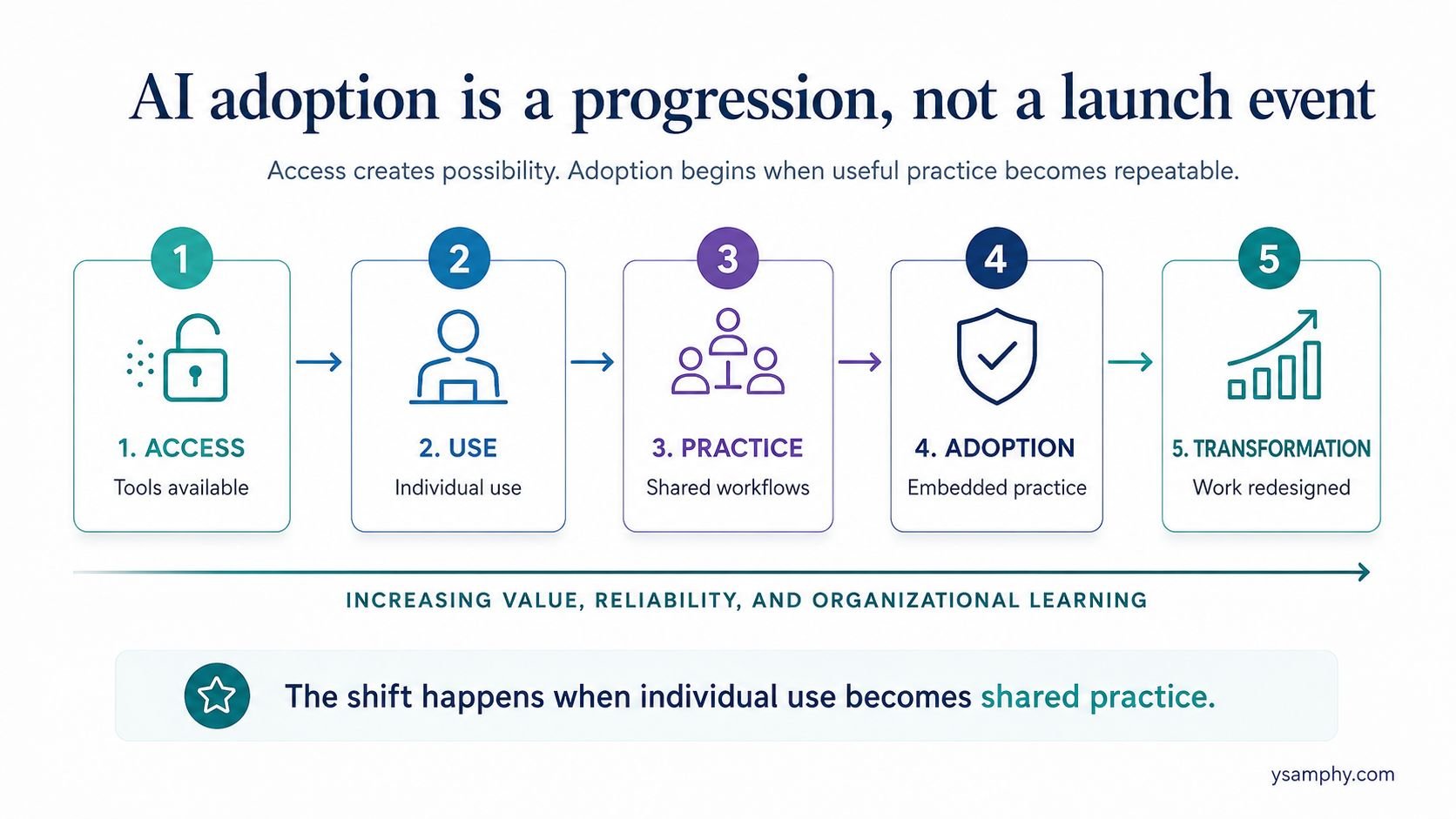
A useful way to think about the progression is:
Access → Use → Practice → Adoption → Transformation
Access makes experimentation possible.
Use creates experience.
Practice develops judgment.
Adoption turns individual experience into an organizational capability.
Transformation becomes possible only after the organization understands where AI creates value and how the surrounding system must change.
This distinction matters because the visible signs of activity can be misleading. A company may have thousands of active users and still have no shared standards, no documented workflows, and no evidence that AI is improving meaningful outcomes.
AI use is growing faster than organizational readiness
AI use is expanding rapidly. Across OECD countries where data were available, 20.2% of firms reported using AI in 2025, up from 8.7% in 2023.[1]OECD, “Artificial intelligence,” firm-level adoption statistics for 2023-2025 McKinsey's 2025 global survey similarly found that nearly nine in ten respondents said their organizations were regularly using AI, while noting that most had not embedded it deeply enough into workflows to generate material enterprise-level benefits.[2]McKinsey & Company, “The State of AI: Global Survey 2025”
The constraint is increasingly organizational rather than individual.
A 2026 McKinsey survey found that 70% of respondents felt personally prepared to adopt and use AI, while only 27% of leaders believed their organizations were ready to make the necessary people and culture shifts. In the same analysis, organizational readiness was more strongly associated with reported enterprise value than personal readiness, and leaders were 5.3 times more likely to report value when workflows had been redesigned rather than left unchanged.[3]McKinsey & Company, “From Adoption to Impact: Three Horizons of AI Transformation,” July 8, 2026
These findings support a practical conclusion:
The challenge is no longer simply getting people to try AI. It is creating the conditions in which useful practices can survive, spread, and improve.
Why AI experiments fail to become repeatable work
Most stalled AI initiatives do not fail for one dramatic reason. They lose momentum through a series of smaller design failures.
1. The organization starts with the tool instead of the problem
The question becomes, “Where can we use this platform?” rather than, “Which meaningful constraint in our work should we improve?”
Tool-first programs often generate long lists of possible use cases. They rarely create enough focus to redesign any one workflow well.
2. The pilot sits outside the real workflow
A demonstration proves that a model can generate an output under controlled conditions.
It does not prove that the output arrives at the right moment, uses the right information, meets quality standards, fits existing systems, or helps a real employee make a better decision.
3. Training teaches features rather than practice
Employees may learn how to prompt, summarize, or generate content. They are not always taught how to frame a real task, prepare appropriate inputs, verify an output, apply professional judgment, or escalate uncertainty.
A tool demonstration creates familiarity. Adoption requires repeated practice in context.
4. Human responsibility remains vague
“Always review AI output” sounds sensible, but it is not operational guidance.
Review for what? By whom? Against which source? At what point? What happens when the employee cannot determine whether the result is correct?
Without clear boundaries, people either trust too much or avoid the tool entirely.
5. Governance is separated from work
Policies often list prohibited behavior but do not help employees make routine decisions.
Good governance should shape the workflow itself: approved tools, data rules, review gates, decision rights, source requirements, escalation paths, and documentation.
6. Managers are missing from the adoption system
Managers translate strategy into expectations, priorities, quality standards, and permission to experiment.
Microsoft's 2026 Work Trend Index reported that employees whose managers actively modeled AI use also reported higher perceived value, more critical thinking about AI use, and greater trust. Psychological safety around experimentation was associated with higher readiness and more frequent use.[4]Microsoft, “2026 Work Trend Index: Agents, Human Agency, and the Opportunity for Every Organization”
A central training team cannot compensate for managers who never discuss the new way of working.
7. The organization measures activity instead of value
Licenses, logins, prompts, and training completion rates are easy to count.
They do not tell leaders whether cycle time improved, quality increased, risk declined, customers received better service, employees developed stronger capabilities, or a workflow became reusable.
8. Individual lessons never become organizational knowledge
One employee discovers a useful pattern. Another finds a serious limitation. A third develops a strong review checklist.
If there is no feedback loop, those lessons remain in personal chat histories and informal conversations. The organization repeatedly pays to learn the same thing.
The Six Conditions of Practical AI Adoption
A practical framework for AI adoption
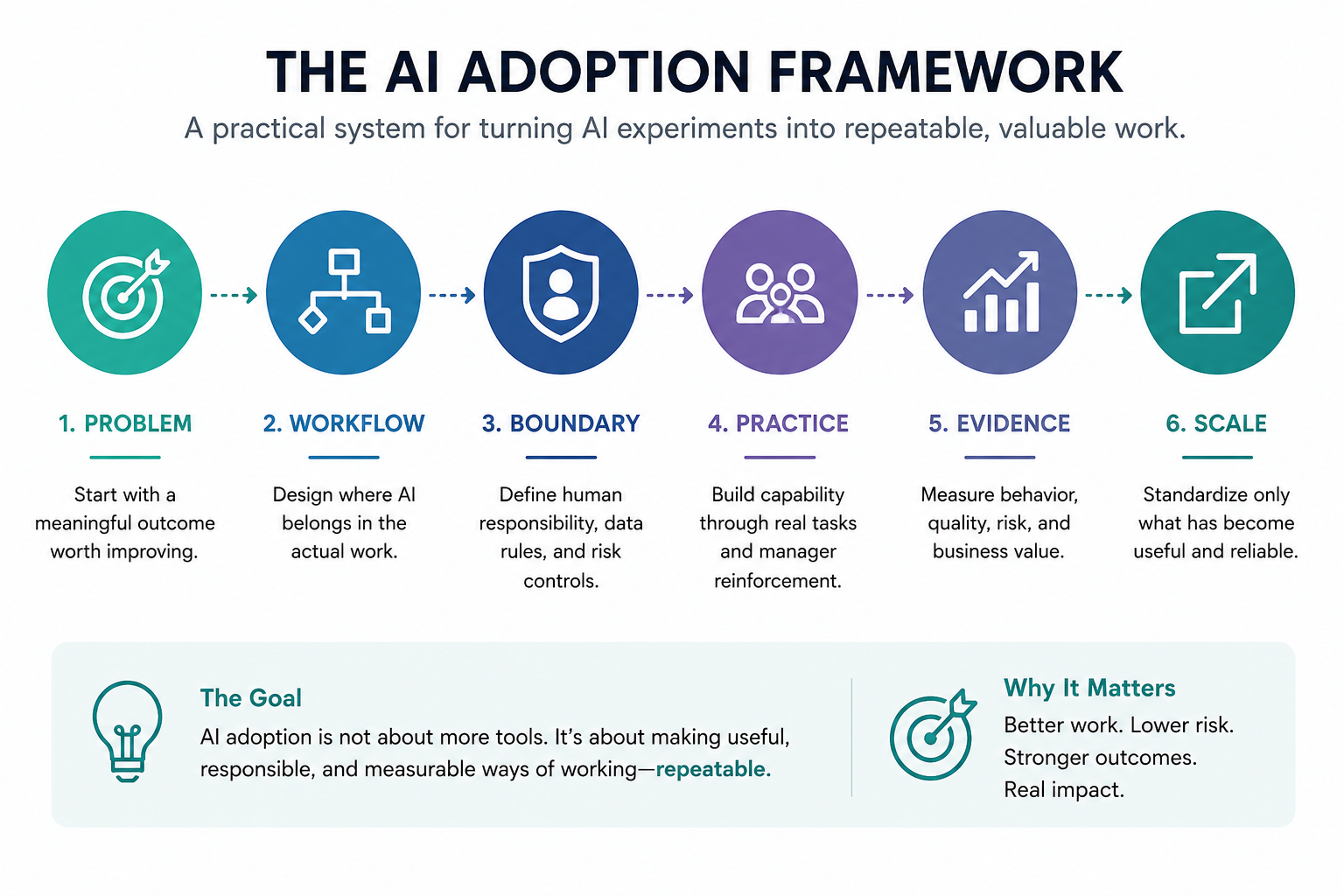
Organizations do not need a more complicated slogan. They need a small set of conditions that can guide decisions from the first use case through scale.
I use six:
- Problem - identify the outcome worth improving.
- Workflow - design where AI belongs in the actual work.
- Boundary - define human responsibility, data rules, and risk controls.
- Practice - build capability through real tasks and manager reinforcement.
- Evidence - measure behavior, quality, risk, and business value.
- Scale - standardize only what has become useful and reliable.
These conditions are connected. A weakness in one usually limits the others.
1. Problem: begin with an outcome worth improving
The first question should not be:
Where can we use AI?
It should be:
Which meaningful problem, constraint, or opportunity are we trying to address?
A strong AI use case begins with the work and its intended outcome.
Examples include:
- Reducing the time required to compare policy versions without weakening legal review.
- Helping instructional designers turn subject-matter interviews into a first set of realistic learning scenarios.
- Improving the consistency of customer-support draft responses while preserving human approval.
- Making authoritative internal knowledge easier to find and cite.
- Helping managers prepare for difficult adoption conversations through simulation and practice.
A useful initial use case usually has several characteristics:
- The task occurs often enough to learn from.
- The current process contains identifiable friction.
- Inputs and desired outputs can be described.
- A knowledgeable person can evaluate quality.
- Errors can be detected before causing serious harm.
- A baseline and outcome can be measured.
- Someone owns the business result.
Poor early candidates often have the opposite qualities: unclear purpose, rare occurrence, highly consequential decisions, unreliable source information, no qualified reviewer, or no accountable owner.
A one-sentence use-case test
Complete this sentence:
We will use AI to help [specific people] perform [defined task] so that [meaningful outcome] improves, while [human responsibility or constraint] remains in place.
For example:
We will use AI to help the L&D team organize interview notes into draft scenarios so that course-development time decreases, while instructional designers verify accuracy, relevance, and learning alignment.
If the sentence remains vague, the use case probably needs more work before the tool does.
2. Workflow: design the human-AI way of working
A pilot often asks whether AI can produce an output.
Adoption asks how the entire workflow should operate.
Before adding AI, map the current process:
- What triggers the work?
- What information is required?
- Who performs each step?
- Where do delays, errors, duplication, or judgment occur?
- What systems and approvals are involved?
- What defines an acceptable result?
Then design the future workflow at the task level.
Do not simply assign “AI” to a whole job. Decide which steps are appropriate for machine assistance and which require human judgment.
A practical workflow might look like this:
- A person identifies the purpose and prepares approved source material.
- AI produces a draft, comparison, classification, or set of options.
- A qualified person verifies the output against authoritative sources.
- The person revises, decides, or escalates.
- The final work is stored with enough context for reuse and audit.
- Lessons from the task improve the workflow.
The workflow should reduce friction, not add theater
AI can make work slower when employees must copy information across disconnected systems, clean up generic output, repeat verification, or navigate unclear approval requirements.
A successful workflow does not merely insert AI into every available step. It removes unnecessary effort while protecting the parts of the work that depend on context, accountability, and expertise.
3. Boundary: make human responsibility operational
Boundaries are the rules that make useful adoption possible.
They answer questions such as:
- What information may be entered into the tool?
- Which systems or models are approved?
- What must be independently verified?
- Which sources are authoritative?
- What decisions may AI support but never make?
- When is additional review required?
- What must be documented?
- When should the employee stop and escalate?
NIST's voluntary AI Risk Management Framework is designed to help organizations incorporate trustworthiness considerations into the design, development, use, and evaluation of AI systems. Its accompanying generative AI profile addresses risks that are distinctive to generative systems.[5]National Institute of Standards and Technology, “AI Risk Management Framework”
An organization does not need to reproduce an entire external framework inside every workflow. It does need to translate risk principles into instructions people can use.
A simple boundary model
For each use case, define five things:
Data boundary
What information can and cannot be used?
Authority boundary
What may AI draft, recommend, or classify, and what must a person decide?
Quality boundary
What evidence or source must be checked before the output is accepted?
Risk boundary
What level of impact requires stronger review, restricted use, or no use?
Escalation boundary
Who helps when the employee cannot confidently resolve an issue?
The purpose is not to create fear. It is to give people enough clarity to act responsibly.
4. Practice: build capability around real work
AI literacy is necessary, but general awareness is not adoption. For a practical curriculum, learn how to design an employee AI training program.
People build durable capability when they practice on relevant tasks, receive feedback, compare approaches, and understand why a result succeeded or failed.
Effective learning should therefore be:
- Role-based: A recruiter, lawyer, instructional designer, manager, analyst, and content strategist face different tasks and risks.
- Workflow-based: Training should use the actual sequence of work, not isolated prompts.
- Evidence-based: Learners should compare the output with source material and quality criteria.
- Social: Teams should discuss limitations, judgment calls, and useful patterns.
- Continuous: Practices should evolve as tools, policies, and workflows change.
Managers are part of the learning infrastructure
Managers should be prepared to:
- Explain why a particular workflow is changing.
- Model appropriate use in their own work.
- Set quality and review expectations.
- Create safe space to report weak outputs and failed experiments.
- Protect time for practice.
- Recognize useful learning, not only flawless results.
AI champions can help, but they should not become an informal support desk with no authority or time. Their role is to connect local experimentation with shared standards and organizational learning.
Scenario-based learning is especially useful
Some AI adoption decisions cannot be learned through a checklist alone.
Leaders may need to balance speed, privacy, employee trust, customer impact, and business pressure. In my AI Strategy Lab VR project, I used an immersive, voice-first executive simulation to create a practice environment for AI adoption and governance decisions. The value of the experience was not the novelty of virtual reality. It was the opportunity to make decisions, hear stakeholder consequences, and reflect before facing a similar situation in real life.
That principle applies beyond XR: practice should reproduce the judgment demands of the work.
5. Evidence: measure more than activity
Measurement should begin before the pilot, not after it.
Without a baseline, organizations often rely on impressions such as “people like it” or “the demo was faster.”
A balanced measurement system includes several layers.
Access
Can the intended users reach the approved capability? Useful indicators include provisioned users, access failures, and tool availability.
Activity
Are people trying the intended workflow? Useful indicators include active users, task frequency, and repeat use.
Behavior
Has the way of working changed? Useful indicators include use of the documented workflow, review compliance, and manager reinforcement.
Performance
Is the work better? Useful indicators include cycle time, quality, rework, error rate, and customer outcomes.
Capability
What can the organization now do reliably? Useful indicators include a reusable workflow, a new service, stronger analysis, or improved knowledge access.
Risk
Are problems detected and controlled? Useful indicators include incidents, overrides, escalations, unsupported claims, and data-policy violations.
Time saved can be useful, but it is incomplete.
If an employee saves twenty minutes and the capacity disappears into more fragmented work, the organization may not capture much value. If a team uses that capacity to improve customer response, deepen analysis, or increase service quality, the value is more meaningful.
A stronger question is:
What useful organizational capability now exists that did not exist before?
Measure the workflow, not the model in isolation
An impressive model can still support a poor process.
The unit of analysis should be the complete human-AI workflow: inputs, generation, review, decision, output, outcome, and learning.
6. Scale: standardize only what deserves to spread
Scaling is not the automatic reward for a completed pilot.
It is a decision based on evidence.
At the end of a pilot, choose among four options:
- Scale: The workflow is useful, responsible, repeatable, and supported.
- Refine: The opportunity remains valuable, but the workflow or boundary needs improvement.
- Pause: A dependency such as data, integration, policy, or capability is not ready.
- Stop: The value is weak, the risk is disproportionate, or the process is worse than the alternative.
Stopping a weak use case is a sign of learning, not failure.
What must exist before scale
A scalable practice usually needs:
- A named business owner.
- A documented workflow.
- Approved tools and access.
- Clear boundaries and escalation.
- Role-based learning and manager support.
- Quality standards.
- Baseline and outcome measures.
- A method for collecting feedback.
- Knowledge and documentation that can be maintained.
- Technical and operational support.
- An understanding of ongoing cost.
Scale also introduces a coordination problem. Local teams should retain enough freedom to improve their work, while the organization provides consistent standards, shared learning, and common measures.
An AI adoption maturity model
Maturity should describe the reliability of the operating system around AI, not the number of tools an organization has purchased.
Level 1: Exploring
Individuals are experimenting through personal accounts or informal prompting, with little shared guidance. The next priority is to select one meaningful workflow and establish basic boundaries.
Level 2: Testing
Selected pilots have sponsors and initial rules. Typical signs include demonstrations, small use-case teams, and early training. The next priority is to define ownership, baseline measures, and human review.
Level 3: Operationalizing
Proven workflows are documented and supported through role-based practice, governance, feedback, and named owners. The next priority is to improve measurement, knowledge, integration, and cross-team learning.
Level 4: Scaling
Repeatable practices are spreading across teams with shared infrastructure, coordinated metrics, and manager reinforcement. The next priority is to maintain quality while adapting to local context.
Level 5: Transforming
Work and value creation are redesigned around proven capabilities. Roles, decision rights, services, structures, or business models may change. The next priority is continuous learning, people development, and monitoring of impact.
Not every organization needs to reach the fifth level everywhere.
A small business may create significant value from a few well-designed workflows. A high-risk function may appropriately remain at a controlled operational level. Maturity should serve the work, not become a prestige score.
90 Days From Experiment to Decision
A 90-day AI adoption roadmap
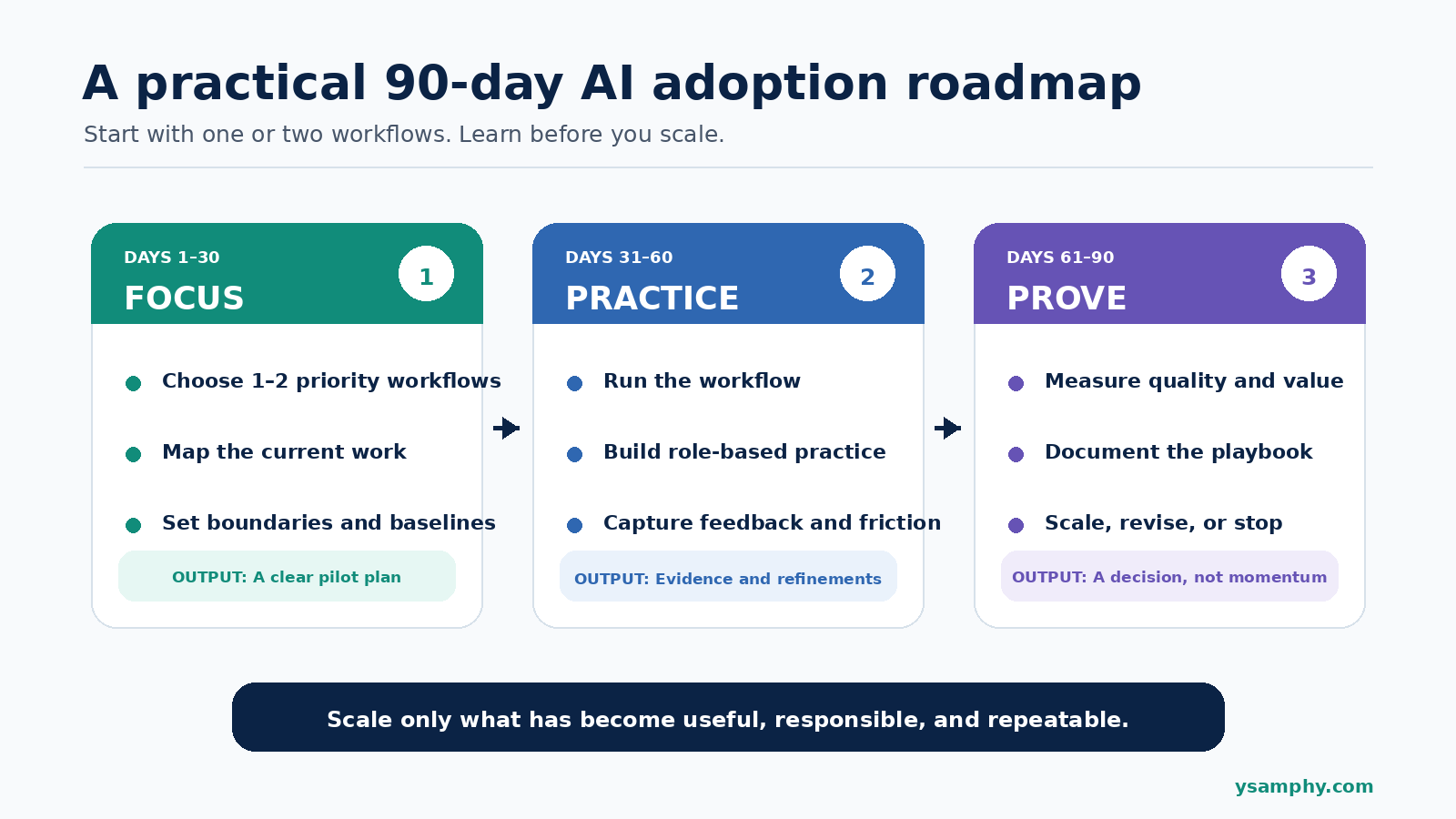
A focused 90-day cycle is long enough to produce evidence and short enough to preserve momentum.
Days 1-30: Define the opportunity
Objective: Choose the right work and establish a responsible starting point.
Actions:
- Select one to three workflows with clear value potential.
- Name a business owner and cross-functional team.
- Map the current workflow and baseline.
- Define the intended human-AI workflow.
- Identify data, quality, legal, security, and workforce considerations.
- Write practical boundaries and escalation rules.
- Agree on success, risk, and stop criteria.
Deliverables:
- One-page use-case brief.
- Current and proposed workflow map.
- Initial risk and boundary sheet.
- Baseline measures.
- Learning and communication plan.
Days 31-60: Practice and validate
Objective: Test the workflow with real users and real work.
Actions:
- Train a small group using representative tasks.
- Let managers model and reinforce the practice.
- Collect examples of strong and weak outputs.
- Observe where people hesitate, bypass controls, or create workarounds.
- Measure quality, effort, rework, confidence, and risk.
- Improve the workflow, instructions, and review points.
- Document reusable lessons.
Deliverables:
- Tested workflow.
- Review checklist.
- Examples library.
- Feedback log.
- Updated guidance.
- Early performance evidence.
Days 61-90: Decide and institutionalize
Objective: Turn evidence into a scale, refine, pause, or stop decision.
Actions:
- Compare results with the baseline.
- Review value, quality, employee experience, and risk.
- Identify the conditions required for wider use.
- Assign long-term ownership and maintenance.
- Create a role-based enablement plan.
- Integrate the workflow with knowledge and support systems.
- Select the next small wave of adoption.
Deliverables:
- Pilot decision record.
- Documented operating procedure.
- Measurement dashboard.
- Support and governance model.
- 90-day improvement backlog.
Who should own AI adoption?
AI adoption is cross-functional, but cross-functional should not mean ownerless.
Executive sponsor: Sets strategic direction, provides resources, and resolves organizational barriers.
Business or workflow owner: Owns the outcome, process, quality standard, and adoption decision.
Managers: Translate the change into daily expectations, model behavior, and create feedback conditions.
Employees and subject-matter experts: Co-design the workflow, apply domain judgment, and surface practical limitations.
L&D and change professionals: Build role-based practice, communication, reinforcement, and capability measurement.
Technology and data teams: Provide approved tools, integration, access, reliability, and technical support.
Security, legal, risk, and governance teams: Define proportionate controls, decision rights, accountability, and escalation.
AI adoption lead or coordinating group: Connect learning across teams, maintain common standards, and support portfolio decisions.
The business owner should remain accountable for the outcome. Technology teams should not be asked to determine whether a workflow creates business value. Governance teams should not be asked to design the work alone. L&D should not be expected to solve weak strategy with more courses.
Knowledge management is part of AI adoption
AI systems work with the knowledge environment they are given.
If definitions conflict, documents are outdated, ownership is unclear, permissions are inconsistent, and important context lives only in people's heads, an AI assistant may retrieve the correct file and still provide the wrong interpretation.
Before scaling an AI workflow, ask:
- Which source is authoritative?
- Who owns it?
- How is it updated?
- Are key terms defined consistently?
- Can the intended users access it?
- Does the content include enough context to guide interpretation?
- Can the system cite or link back to the source?
This is why knowledge management is becoming part of AI infrastructure.
In my article on AI productivity systems for knowledge workers, I make a related distinction: AI can accelerate drafting, summarizing, structuring, and comparison, while human expertise remains responsible for verification, judgment, and approval.
That principle becomes stronger at the organizational level. Reliable AI adoption depends on reliable knowledge practices.
Governance should enable responsible action
Governance is often presented as a choice between speed and control.
That is a false choice when the controls are designed well.
Unclear governance slows adoption because employees do not know what they can do. Overly broad restrictions drive experimentation into unmanaged channels. Weak controls create incidents that damage trust and make future adoption harder.
Practical governance should be proportionate to the use case.
Illustrative risk tiers
Lower-risk support
Examples: brainstorming with non-sensitive information, reformatting text, generating questions, or creating low-stakes first drafts.
Typical controls: approved tool, basic verification, and ordinary accountability.
Moderate-risk assistance
Examples: summarizing internal records, analyzing feedback, drafting recommendations, or supporting operational decisions.
Typical controls: source verification, defined reviewer, documentation, and escalation.
Higher-risk or consequential use
Examples may include employment, legal, health, financial, safety, eligibility, or public-facing decisions, depending on context and jurisdiction.
Typical controls: specialist review, stronger documentation, testing, monitoring, formal approval, restricted use, or a decision not to use AI.
These are illustrative categories, not legal advice. Each organization should adapt controls to its obligations, industry, stakeholders, and risk tolerance.
Practical examples of AI adoption
The framework becomes clearer when applied to real work.
Example 1: Learning and development
Problem: Course development is slowed by the time required to organize interviews with subject-matter experts.
Workflow: AI helps convert approved interview notes into a first set of themes and draft scenarios.
Boundary: Instructional designers verify accuracy, remove unsupported content, and align every scenario with a learning objective.
Practice: Designers compare outputs, improve instructions, and discuss where AI produces generic or unrealistic situations.
Evidence: Development time, scenario quality, SME revision rate, and learner relevance.
Scale: The workflow becomes a documented course-design practice with examples and review standards.
Example 2: Legal or policy comparison
Problem: Reviewers spend significant time identifying differences between document versions.
Workflow: AI produces an initial comparison and organizes changes by section.
Boundary: A qualified person determines legal meaning, checks completeness, and approves the conclusion.
Practice: Reviewers learn which types of changes the system misses or misclassifies.
Evidence: Review time, missed changes, rework, and escalation frequency.
Scale: The organization creates an approved comparison process, source requirements, and verification checklist.
Example 3: Internal knowledge support
Problem: Employees struggle to find current answers across policies, procedures, and project documentation.
Workflow: An AI assistant retrieves information from a governed knowledge base and links to authoritative sources.
Boundary: Sensitive topics require escalation; the assistant cannot invent policy or substitute for specialist judgment.
Practice: Employees learn how to ask precise questions and verify the cited source.
Evidence: Search time, answer accuracy, source-use rate, unresolved queries, and employee trust.
Scale: Content owners maintain the source material, definitions, permissions, and feedback process.
Example 4: AI adoption and governance simulation
Problem: Leaders understand policies in theory but have limited practice balancing competing stakeholder needs.
Workflow: A voice-first immersive scenario presents an adoption decision and allows leaders to question AI characters representing different stakeholders.
Boundary: Characters operate within designed narrative and knowledge constraints; the simulation supports reflection rather than issuing a final answer.
Practice: Participants make decisions, receive consequences, and discuss trade-offs.
Evidence: Decision quality, reasoning, confidence, and transfer to real workplace conversations.
Scale: The simulation becomes one element in a broader leadership and governance program.
You can see the underlying project in my AI Strategy Lab VR case study and the related Story Rails framework for AI character guardrails.
AI adoption for small businesses
Small organizations do not need an enterprise transformation office to begin.
They do need discipline.
A practical small-business starting point is:
- Choose one recurring workflow.
- Name one owner.
- Use one approved tool.
- Write one page of boundaries.
- Train the people who perform the task.
- Measure one or two meaningful outcomes.
- Review the evidence after thirty days.
The advantage of a smaller organization is speed and proximity to the work. The risk is informality: knowledge may remain undocumented, accounts may be unmanaged, and practices may depend on one enthusiastic person.
Keep the system lightweight, but make it visible and repeatable.
AI adoption in larger organizations
Larger organizations need the same six conditions, but coordination becomes more important.
They often need:
- A portfolio view of use cases.
- Shared technical and knowledge infrastructure.
- Common risk tiers and approval paths.
- Business-led roadmaps.
- Role-based learning at scale.
- Manager enablement.
- Cross-functional metrics.
- Communities of practice or champions.
- A mechanism for transferring learning between teams.
- Clear ownership for maintenance and cost.
The coordinating group should behave less like a command center and more like a learning system. It should create consistent standards, collect evidence, connect teams, and help proven practices spread without forcing every function into the same workflow.
AI adoption readiness checklist
Before expanding an AI initiative, ask:
Problem and value
- Is the intended outcome specific and meaningful?
- Is there a named business owner?
- Is the use case focused enough to learn from?
- Is there a baseline?
Workflow
- Has the current work been mapped?
- Is the role of AI defined at the task level?
- Are human review points explicit?
- Is the future workflow documented?
Boundary and governance
- Are data rules clear?
- Are decision rights clear?
- Are quality and source requirements defined?
- Is there an escalation path?
Practice and capability
- Is learning connected to real work?
- Do managers understand their role?
- Is there protected time for practice?
- Can teams share lessons and limitations?
Evidence and scale
- Are quality, behavior, value, and risk measured?
- Are scale, refine, pause, and stop criteria explicit?
- Is there a long-term owner?
- Can the knowledge and workflow be maintained?
If several answers are no, the organization probably needs better adoption design before it needs more tools.
Download the AI Adoption Readiness Scorecard
The AI Adoption Readiness Scorecard and 90-Day Action Plan turns the framework in this guide into a practical assessment.
It evaluates six dimensions:
- Problem and value
- Workflow design
- Boundaries and governance
- Practice and capability
- Evidence and measurement
- Scale and sustainability
The workbook includes:
- Thirty assessment statements.
- Automatic dimension and maturity scores.
- A results dashboard.
- A 90-day action-planning worksheet.
- A 60-minute facilitation guide.
Download the AI Adoption Readiness Scorecard
Enter your email to receive the Excel scorecard and printable workshop version. You will also receive The Weekly Signal, my short weekly note on better work, clearer thinking, and practical systems. You can unsubscribe at any time.
Frequently asked questions about AI adoption
AI adoption is the process of integrating AI into real work so that people use it consistently, responsibly, and with measurable value. It includes workflow design, skills, management support, governance, measurement, and continuous improvement.
Implementation is primarily the technical deployment of a system or capability. Adoption occurs when people incorporate it into useful, repeatable work with appropriate support and controls. A system can be implemented without being adopted.
Common reasons include an unclear business problem, weak workflow integration, one-time training, vague human responsibility, poor knowledge or data foundations, missing manager support, and measurement focused on activity rather than value.
A business or workflow owner should be accountable for the outcome. Effective adoption also requires managers, employees, L&D or change professionals, technology and data teams, and appropriate security, legal, risk, or governance expertise.
Use a balanced set of indicators covering access, repeated use, behavior change, workflow performance, quality, organizational capability, employee experience, and risk. Do not rely only on licenses, logins, prompts, or estimated time saved.
A focused workflow can produce useful evidence within a 30- to 90-day cycle. Wider adoption takes longer because it requires learning, management reinforcement, integration, governance, knowledge maintenance, and operational ownership. The timeline should depend on the use case and risk, not an arbitrary enterprise deadline.
An AI adoption maturity model describes how an organization progresses from informal experimentation to tested, operationalized, scaled, and potentially transformed ways of working. Maturity should be assessed by the quality of the surrounding system, not the number of AI tools in use.
No. Some work does not benefit from AI, and some decisions should remain fully human. The objective is not maximum usage. It is appropriate, valuable, and responsible use.
The real goal of AI adoption
The goal is not to get everyone prompting.
It is not to maximize the number of active users.
It is not to add AI to every task.
The goal is to help people improve meaningful work without losing the judgment, accountability, trust, and context that make the work valuable.
Practical AI adoption begins with a problem worth solving. It designs the workflow, defines the boundaries, builds capability through practice, measures evidence, and scales only what deserves to spread.
The technology will continue to change.
Organizations that learn how to redesign work responsibly will be better prepared for whatever comes next.
