Interleaving practice means mixing related problem types so you must decide which approach each problem needs. Instead of completing every example of one type before moving on, you alternate among types you have already begun learning.
It is especially useful when you can follow a procedure but struggle to recognize when to use it. A mixed set makes that choice part of the practice. You will see how it works, try six percentage problems, and build a small set of your own with the free planner.
Start here: Learn the individual methods, mix a few related types, explain your choice, check your answer, and try fresh problems later. If you cannot yet carry out a method with guidance, return to instruction before adding more variety.
Interleaving versus blocked practice
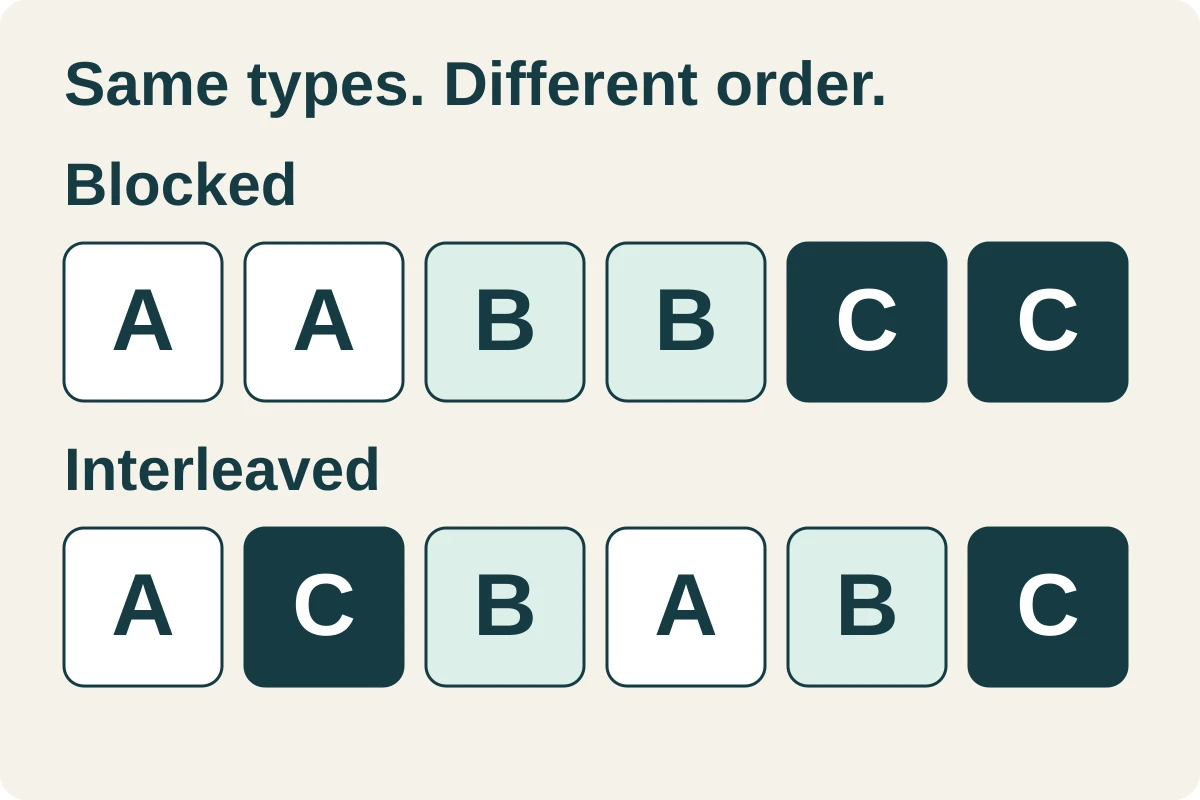
Blocked practice groups exercises by type. If A means finding a percentage of an amount, B means finding a part’s percentage share, and C means finding percentage change, a blocked sequence might be A, A, B, B, C, C.
An interleaved sequence might be A, C, B, A, B, C. You still finish one problem before beginning the next. What changes is the decision you must make at the start of each one.
| Practice format | What the learner does | Useful role |
|---|---|---|
| Blocked | Repeats one method before changing types | Getting familiar with a method or repairing a specific step |
| Interleaved | Chooses among methods from the problem itself | Practicing distinctions and strategy selection |
| Unrelated task switching | Moves among activities with different goals | Not the learning design described here |
A worksheet headed “Percentage change” has already supplied a major clue. Even perfect answers may tell you little about whether you would recognize that method in an unlabeled task.
Interleaving removes that clue. The aim is not to make study feel chaotic or to switch between email, algebra, and social media. Choose a coherent learning goal, such as distinguishing several kinds of percentage questions.
What benefits does the research support?
Research provides good reasons to try interleaving, particularly for some mathematical and category-learning tasks. It does not establish that mixing everything is always better.
In Taylor and Rohrer’s mathematics experiment, children practiced four problem types while the amount of spacing was held fixed. Interleaving reduced performance during practice but improved performance on the next-day test. The error analysis suggested that learners became better at matching a problem to the appropriate procedure.
That distinction matters: completing today’s worksheet fluently and being able to choose a method tomorrow are different outcomes.
A study of undergraduate physics homework also found better performance on surprise tests involving new, more challenging problems after interleaved practice. Students nevertheless tended to perceive interleaving as harder and less effective. The study supports this approach in that course setting; it does not predict a particular improvement for your subject or study routine.
The boundaries matter too. In 2025 category-learning experiments, the better sequence depended on the instructed learning strategy. Interleaving helped similarity-based classification, while blocking helped rule-based classification; the pattern persisted after about 48 hours. This was a particular laboratory task, not a verdict that all rule-based subjects should be blocked.
The practical lesson is to ask what the sequence is helping you learn. Are you learning the steps, noticing what examples have in common, or choosing between methods that are easy to confuse? Evaluate the result with later, unfamiliar questions rather than the feeling of difficulty alone.
A worked interleaving example: three percentage questions
The following fictional workplace-learning example is an original practice set, not a tested training intervention. Imagine someone preparing to interpret a simple operations report. They can calculate percentages but sometimes choose the wrong denominator.
The learning goal is specific: identify what the question asks for, select the correct base, and then calculate.
First, learn the three methods
A. Find a percentage of an amount. You know the whole and the rate; you need the part. For example, 20% of 150 units is 0.20 × 150 = 30 units. The answer has the same unit as the original amount.
B. Find a part’s percentage share. You know the part and whole; you need a percentage. If 30 of 150 tasks are complete, the completed share is 30 ÷ 150 × 100 = 20%.
C. Find percentage change. You compare a new value with its starting value: (new − old) ÷ old × 100. A rise from 150 to 180 is 30 ÷ 150 × 100 = 20%. The starting value is the base. A negative result means a decrease; this ordinary formula is undefined when the starting value is zero.
If any method is unfamiliar, study its worked example and solve a few similar questions with feedback before proceeding. That is useful blocked preparation. The eventual mixed set should test choosing among methods you have had a chance to learn.
Now try the mixed set
Hide the method descriptions and answer key. For each question, write the requested quantity, the method and base, and your calculation. A calculator is fine if the skill you want to practice is choosing the method rather than arithmetic.
- A team has a $2,400 project budget and reserves 15% for contingencies. How many dollars are reserved?
- Registrations increase from 80 to 100. What is the percentage increase?
- A team completes 18 of its 60 planned tasks. What percentage of the tasks is complete?
- Of 750 items checked, 12% need a second inspection. How many items need that inspection?
- Of 180 support requests, 45 concern billing. What percentage concerns billing?
- Average waiting time falls from 50 minutes to 40 minutes. What is the percentage change?
Avoid adding labels such as “percentage share” above individual questions. Those labels would give away the selection you are trying to practice. The planner may record the category privately; the learner-facing set should not reveal it.
Answer and feedback key
1. $360. This asks for an amount, so use A: 0.15 × $2,400. The budget is the whole. A response of 15% repeats the given rate rather than answering the question.
2. A 25% increase. Use C: (100 − 80) ÷ 80 × 100. The starting 80 is the base. Dividing the increase by the new total, 100, produces 20%, which answers a different question.
3. 30%. Use B: 18 ÷ 60 × 100. Completed tasks are the part; planned tasks are the whole. Multiplying 18 by 60 does not express their relative share.
4. 90 items. Use A: 0.12 × 750. This requests a count. The answer is 90 items, not 90%.
5. 25%. Use B: 45 ÷ 180 × 100. This is a share of one total, not a change between an old and new value.
6. −20%, or a 20% decrease. Use C: (40 − 50) ÷ 50 × 100. Keep the starting 50 as the base. The decrease is 10 minutes; that absolute difference is not itself a percentage.
The order was A, C, B, A, B, C. Simply knowing that pattern would weaken the next attempt, so use fresh values and a different order when you return.
Separate a selection error from an execution error. Choosing percentage change for question 5 suggests a distinction needs work. Choosing the correct share calculation but making a division error calls for a different correction.
How to build your own interleaved practice set
1. Choose a small family of related tasks
Start with two or three types you need to tell apart. That is a manageable design suggestion, not a research-proven optimum.
For example, a spreadsheet learner might choose among adding matching values, counting matching rows, and retrieving a matching record. The common goal is deciding what the question requires before writing a formula. Use the functions and answer checks taught in your actual course or software documentation.
Mixing entire unrelated subjects may vary your study day, but it does not automatically practice these distinctions.
2. Write the distinguishing cue for each type
Use a cue that explains the problem’s structure, not just a keyword. For percentages, “needs an amount,” “needs a share of a whole,” and “compares a new value with a starting value” are more useful than spotting the word “of.”
Include a nearby alternative: why does this method fit better than another one? That explanation is often where a misunderstanding becomes visible.
3. Prepare answers before you shuffle
Use trusted course exercises, an instructor’s solutions, or problems you can independently verify. Write a brief rationale for the method as well as the result. An unverified answer key can teach the same mistake repeatedly.
Keep a creator’s copy with categories and a learner’s copy without them. Mix the types without leaving a predictable A-B-C cycle. Changing numbers alone is not enough if the heading or repeated layout still reveals the method.
4. Attempt, check, and repair
Finish each problem before switching. Say why your chosen method applies, then compare with the key. For independent study, checking after an attempt can help you correct a misunderstanding before repeating it across the set. A teacher may choose a different feedback arrangement.
If you keep confusing the same pair, place one worked example of each side by side and describe the difference. If you chose correctly but cannot execute the steps, briefly practice that method on its own. Then return to fresh mixed questions.
5. Check later with unfamiliar questions
Set a later session, such as a few days afterward, and use new examples without category labels. Choose the timing to fit your deadline; no single gap is right for every learner and task.
Record method choice and execution separately. A better later attempt is more informative than “this felt productive.” One small personal trial still cannot prove that interleaving caused the change, but it can show what you need to practice next.
When should you use blocked practice?
Blocked practice remains a useful tool when the immediate job is learning or repairing a procedure. You do not have to choose one format forever.
- You are new to a method. Begin with an explanation and worked examples. Try similar problems with support, then remove some support before mixing types.
- One step keeps failing. Isolate that step for a short repair session. Return to mixed practice afterward so the exercise heading does not become a permanent crutch.
- You are trying to identify a common rule. Comparing several examples together may help you see what they share. Check whether your chosen sequence supports the particular learning goal.
- The mixed set is mostly guessing. Reduce the number of types, restore an example or cue, or ask for instruction. Confusion is not automatically productive difficulty.
Conversely, if you can solve every exercise when its chapter supplies the method but freeze on a mixed test, more of the same blocked work may leave the selection problem untouched.
Combine interleaving with recall, spacing, and feedback
These approaches answer different questions:
- Interleaving: Which types appear next to each other, and must I choose the method?
- Active recall: Am I producing an answer before looking at the explanation?
- Spaced repetition: When will I return to the material after a gap?
- Deliberate practice: What specific weakness am I working on, and how will feedback change the next attempt?
A session can use all four. Work on a specific selection error, answer mixed questions without notes, inspect the feedback, and revisit fresh examples later. Interleaving itself does not guarantee that you recalled anything unaided or planned a later review.
For help making the feedback more useful, these deliberate practice examples show how to design a focused practice task.
Download the interleaving practice planner
The four-page planner includes a blank set builder, a mixed-question and correction log, the percentage exercise with worked starter examples, and its explanation key. Use the PDF for printing or edit the Word version to build a different practice set.
Keep the answer key and category map out of view while attempting the questions. Start with one small decision you need to get better at, then judge the practice by what you can do on fresh questions later.
For more practical ideas about learning and better work, read about The Weekly Signal.