Practicing more does not always mean improving more.
You can write every week without becoming a noticeably better writer. You can deliver the same presentation repeatedly while keeping the same weak opening. You can spend years doing a job while avoiding the parts of the work that would stretch your ability.
Experience helps, but experience can also automate your existing habits, including your mistakes.
Experience doesn't guarantee expertise. Sometimes, it just automates your mistakes.
Deliberate practice is different.
It focuses your attention on a specific weakness, gives you a task designed to improve it, provides useful feedback, and changes your next attempt.
That sounds simple. It is not easy.
This guide explains what Anders Ericsson meant by deliberate practice, how it differs from ordinary and purposeful practice, what the research does and does not support, and how to design a practical improvement session for your own work.
What Is Deliberate Practice?
Deliberate practice is a highly structured form of practice designed to improve a specific part of performance.
Instead of repeating an entire activity, you isolate a weakness or subskill, work on a demanding task, receive feedback, make an adjustment, and try again.
A deliberate-practice session therefore has several characteristics:
- It targets a specific skill or weakness.
- It has a clear improvement goal.
- It requires concentrated attention.
- The task is challenging but possible.
- Feedback reveals what needs to change.
- The next attempt incorporates that feedback.
- The difficulty increases as performance improves.
Anders Ericsson, Ralf Krampe, and Clemens Tesch-Römer introduced the deliberate-practice framework in their influential 1993 research on expert performance.
Ericsson later emphasized a relatively strict definition. In established fields such as classical music, chess, and some sports, a qualified teacher or coach can identify weaknesses, design appropriate exercises, and provide feedback based on a well-developed body of knowledge.
When that kind of expert-designed practice structure is absent, Ericsson often used the term purposeful practice instead.
That distinction matters because much of what is casually called deliberate practice is better described as focused, purposeful self-improvement.
Naive Practice, Purposeful Practice, and Deliberate Practice
These terms describe different ways of practicing.
Practice Type | Main Characteristics | Example |
|---|---|---|
Naive | Repeating the activity | Writing more articles |
Purposeful | Targeted goal and feedback | Practicing ten article openings |
Deliberate | Expert-designed training within a developed field | A coach assigns progressive exercises |
Naive practice
Naive practice means doing the activity repeatedly.
A writer writes more articles.
A speaker gives more presentations.
A facilitator leads more meetings.
A musician plays familiar pieces.
Repetition can build familiarity, confidence, and automaticity. But once you become comfortable, repetition may maintain your current level rather than improve it.
Purposeful practice
Purposeful practice introduces a clear goal and feedback.
Instead of simply writing another article, you might practice writing ten different openings and evaluate which ones create the clearest reason to continue reading.
Instead of delivering the whole presentation again, you might record only the first three minutes, assess your pace and clarity, and repeat the opening after making one adjustment.
Purposeful practice is particularly useful for knowledge workers because many modern professional skills do not have a universally accepted training system or a coach who can prescribe every exercise.
Deliberate practice
Under Ericsson’s stricter definition, deliberate practice occurs in fields where expert performance can be measured and effective training methods have developed over time.
A capable teacher or coach can:
- Assess your current performance
- Identify an important weakness
- Choose an exercise appropriate to your level
- Observe the result
- Provide corrective feedback
- Increase the difficulty as you improve
This does not mean self-directed improvement is useless.
It means we should be precise about what we are doing. A self-designed feedback loop may be excellent purposeful practice even when it does not meet every criterion of Ericsson’s strict definition.
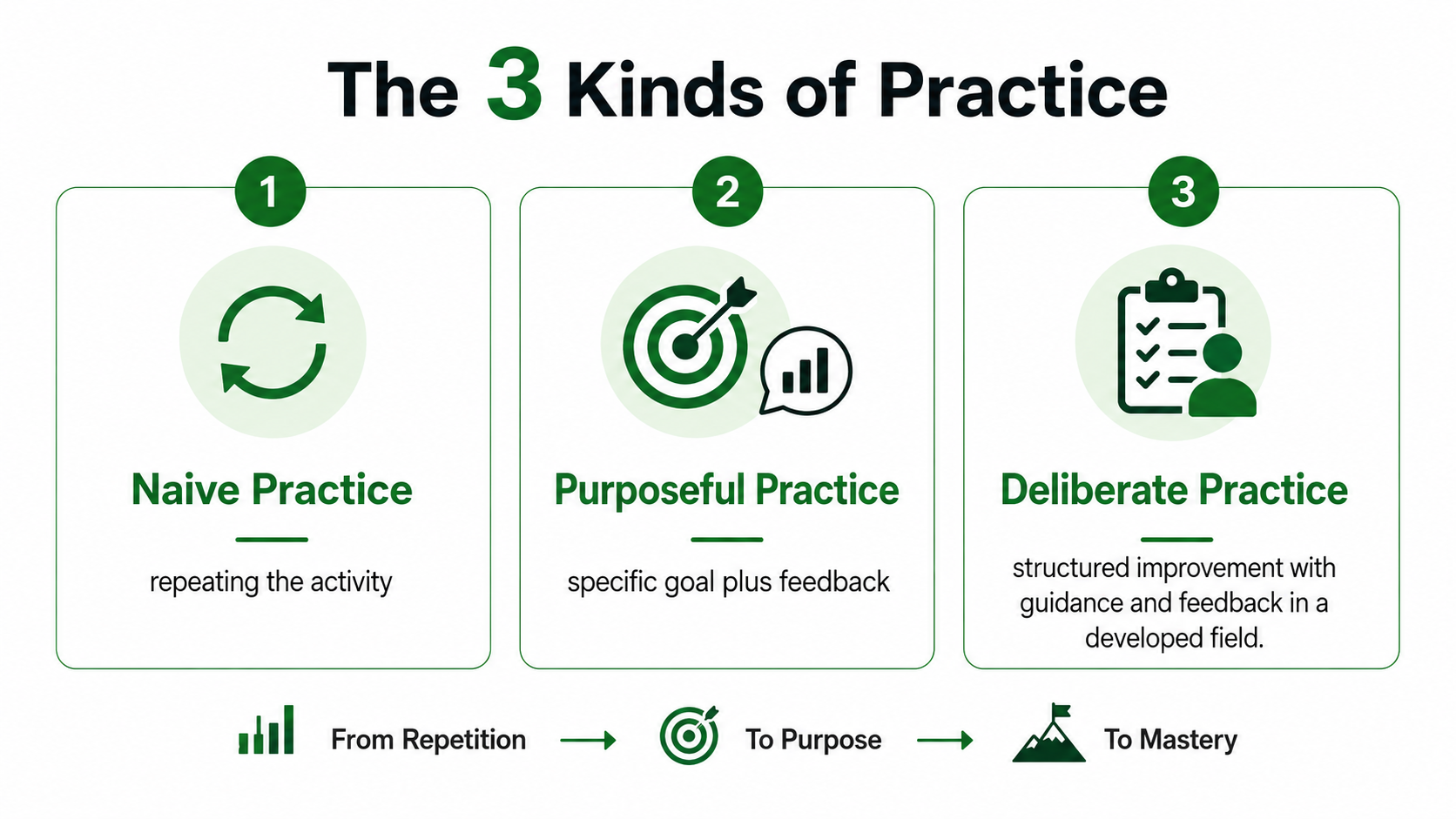
Naive practice repeats the activity, purposeful practice adds a clear goal and feedback, and deliberate practice uses structured guidance in a developed field.
Why Deliberate Practice Matters, and Its Limits
The core insight behind deliberate practice is powerful:
Improvement depends less on repeating the whole performance and more on repeatedly correcting the right part of it.
The method directs effort toward the gap between current and desired performance.
That can make practice more useful because it prevents you from spending all your time doing what already feels comfortable.
However, deliberate practice should not be treated as a guarantee of expertise.
Researchers agree that structured practice matters, but they disagree about how much of the difference between performers it explains.
Ericsson and his collaborators argued that researchers should preserve a strict definition and measure the quality of practice, not merely count hours. Other researchers have argued that practice explains only part of performance differences and that opportunity, cognitive characteristics, physical traits, starting conditions, instruction, and the nature of the field can also matter.
The responsible conclusion is not that deliberate practice explains everything or nothing.
It is that well-designed practice is an important influence on improvement, but it works within a larger system of ability, access, environment, feedback, health, opportunity, and sustained effort.
The 10,000-Hour Rule Is Not a Rule
Malcolm Gladwell helped popularize deliberate-practice research through the idea that mastery requires 10,000 hours.
Ericsson later objected to treating that number as a universal threshold.
Different skills have different demands. Learners begin from different positions. Practice quality varies. Coaching access varies. Standards of expertise vary. Some domains have clearer training structures than others.
Counting hours can also create the wrong incentive.
Ten thousand hours spent repeating the same comfortable activity are not equivalent to ten thousand hours of targeted improvement.
A more useful question is:
What is this practice session designed to improve?
Time matters because meaningful improvement usually requires sustained effort. But hours alone do not tell you whether practice is working.
The Five Elements of Effective Deliberate Practice
Whether you are working with a coach or adapting the method independently, five elements make practice more likely to produce improvement.
1. A narrowly defined target
Do not practice “writing,” “leadership,” “SEO,” or “public speaking” as one undifferentiated skill.
Choose a subskill.
For example:
- Writing clearer openings
- Explaining technical ideas without jargon
- Asking stronger follow-up questions
- Making cleaner transitions between presentation sections
- Writing search titles that match intent
- Maintaining narrative boundaries for an AI character
- A narrow target makes feedback and adjustment possible.
2. A task slightly beyond your current performance
The task should be difficult enough to expose weakness but not so difficult that the result teaches you nothing.
If the task is too easy, you repeat what you already know.
If it is far beyond your ability, failure may be too broad to diagnose.
The best exercise often isolates one difficult component while keeping the rest of the task manageable.
3. Full attention
Deliberate practice requires you to notice what you are doing.
That is difficult when you are:
- Answering messages
- Switching among several tasks
- Practicing for too long
- Performing automatically
- Trying to improve five things at once
Focused attention does not automatically make an activity deliberate practice. But without attention, it becomes difficult to observe errors and make precise adjustments.
This is where deliberate practice and Deep Work support one another.
Deep work creates the conditions for concentration. Deliberate practice determines what you will concentrate on and how the feedback will change your performance.
4. Useful feedback
Feedback tells you how the attempt differs from the desired result.
It may come from:
- A teacher or coach
- An editor
- A knowledgeable colleague
- A rubric
- A recording
- A test
- User behavior
- Performance data
- A simulation
- A comparison with an expert model
Useful feedback is specific enough to guide the next attempt.
“Good job” is encouraging but not diagnostic.
“This explanation becomes unclear when you introduce three concepts before defining the first one” gives you something to change.
5. Repetition with adjustment
Repeating the task is not enough.
Each attempt should reflect what you learned from the previous one.
If the feedback does not change the next attempt, the loop is incomplete.
Practice becomes deliberate when the feedback changes the next attempt.
The Deliberate Practice Loop
A useful way to remember the process is:
Target → Attempt → Feedback → Adjustment → Repeat
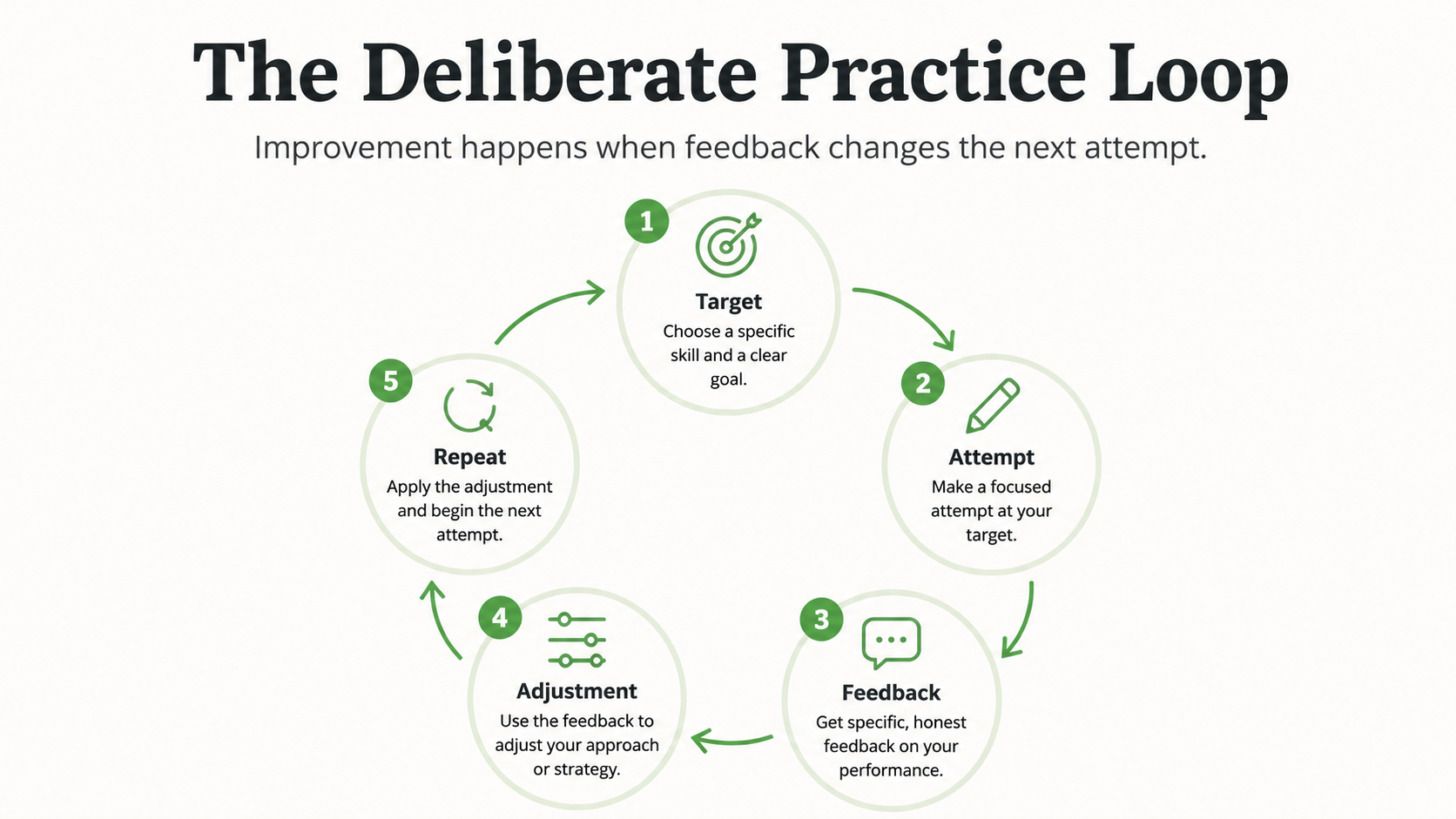
Improvement happens when feedback changes the next attempt.
Target
Choose one subskill or weakness.
Attempt
Perform a short exercise that makes the skill observable.
Feedback
Compare the result with a standard, rubric, expert model, or informed response.
Adjustment
Choose one thing to change.
Repeat
Try the same or a similar exercise while applying the adjustment.
The loop should be small enough that you can repeat it several times without waiting weeks for another opportunity.
Improve the System, One Week at a Time
The Weekly Signal is a short weekly note for better work, clearer thinking, and practical systems you can actually use.
Practical Deliberate Practice Examples
Writing
Weak approach: Write more articles and hope your writing improves.
Better practice design:
- Choose one issue, such as weak introductions.
- Write ten introductions for the same article.
- Evaluate them using a rubric: clarity, specificity, tension, and reader promise.
- Ask an editor or informed reader to rank the strongest three.
- Identify why the weaker openings fail.
- Rewrite the weakest three.
- Record one principle to use in the next article.
The target is not “write more.”
It is “improve the ability to open an article clearly and compellingly.”
Presentations
Weak approach: Rehearse the full presentation repeatedly.
Better practice design:
- Record the first three minutes.
- Evaluate only pace, clarity, and the transition into the main idea.
- Ask a colleague where attention drops.
- Rewrite one confusing transition.
- Record the opening again.
- Compare both versions.
A short feedback loop may produce more improvement than another complete rehearsal.
Facilitation
In facilitation, the weakness might be giving advice too quickly rather than helping participants think.
A practice exercise could be:
- Conduct a five-minute simulated conversation.
- Practice asking only follow-up questions.
- Record the exchange.
- Mark every moment when you replaced inquiry with advice.
- Rewrite those moments as questions.
- Repeat the simulation.
This isolates a skill that is difficult to improve merely by facilitating more meetings.
SEO and content strategy
Suppose the target is writing clearer search titles.
A practice session could involve:
- Choose one search intent.
- Draft ten titles for the same article.
- Evaluate each title for intent alignment, clarity, specificity, and unnecessary words.
- Compare them with high-performing search results.
- Select the strongest two.
- Test one on an appropriate page.
- Review Search Console data after enough impressions accumulate.
The performance data becomes feedback, although it must be interpreted carefully because titles are not the only factor affecting clicks.
AI characters and immersive learning
During my AI Strategy Lab VR work, one challenge was keeping an AI character useful without allowing the conversation to leave the intended learning experience.
“Build a better character” would have been too broad.
A more useful practice loop was:
- Identify one failure mode, such as leaving the scenario.
- Write several prompts designed to trigger that failure.
- Test the character’s responses.
- Record where the guardrail failed.
- Adjust one instruction or narrative boundary.
- Run the same test again.
- Keep the change only when it improved the behavior without damaging normal conversation.
That is closer to deliberate improvement because the task, failure, feedback, and adjustment are clearly connected.
For more applied scenarios, see Deliberate Practice Examples.
Do You Need a Coach?
Under Ericsson’s strict definition, guidance from a qualified teacher or coach is central because the coach knows:
- How expert performance develops in the field
- Which weaknesses matter at your level
- Which exercises address those weaknesses
- How difficult the next task should be
- What good performance looks like
- Which feedback will produce improvement
A coach can see errors that the learner does not yet know how to recognize.
But not every professional skill has a formal coach or an established training curriculum.
Without one, you can still use purposeful-practice principles.
Possible feedback sources include:
- Editors
- Peers
- Mentors
- Clients
- Users
- Recordings
- Rubrics
- Simulations
- Tests
- Analytics
- Before-and-after comparisons
The key is not merely obtaining more feedback.
It is obtaining feedback that is relevant, specific, and connected to the skill you are practicing.
What Did Ericsson’s 1993 Deliberate Practice Study Actually Find?
Ericsson’s argument about expert performance was not based only on theory. In 1993, he published The Role of Deliberate Practice in the Acquisition of Expert Performance with Ralf Krampe and Clemens Tesch-Römer. The paper combined a broader review of expertise research with two studies of musicians: one involving violinists and another comparing expert and amateur pianists.
The researchers wanted to understand why people who had trained in the same field for many years could still reach very different levels of performance. Their central proposal was that experience alone was not enough. What mattered was prolonged engagement in activities designed specifically to improve performance.
How the Violinist Study Was Conducted
The best-known part of the paper examined 30 young violinists at a music academy in Berlin. The participants were divided into three groups:
- The most accomplished violin students
- Other highly capable violin students
- Students training to become music teachers
The researchers also collected information from 10 professional violinists for comparison.
They interviewed the musicians about their training histories and asked them to estimate how much time they had spent practicing during different stages of their development. The young violinists also kept detailed activity diaries for one week, recording practice, lessons, performances, sleep, leisure, and other activities.
Among the activities the violinists evaluated, practicing alone was consistently rated as the most relevant to improving violin performance.
This did not mean that lessons, performances, or playing with others were unimportant. Solitary practice simply gave musicians more control over what they worked on. They could isolate difficult passages, repeat them, identify errors, and concentrate on specific weaknesses.
The Differences in Accumulated Practice
By age 18, the most accomplished young violinists reported approximately 7,410 accumulated hours of solitary practice.
The other highly capable violinists reported about 5,301 hours, while the future music teachers reported approximately 3,420 hours.
The professional violinists recalled practice histories similar to those of the most accomplished student group at the same age.
The second study found a comparable pattern among pianists. By age 18, expert pianists reported approximately 7,606 hours of accumulated practice, compared with about 1,606 hours among amateur pianists.
These findings supported the researchers’ argument that higher levels of musical performance were associated with substantially greater amounts of structured practice accumulated over many years.
However, the study showed an association. It did not prove that practice hours alone caused all the differences between the groups.
The musicians had not been randomly assigned to practice different amounts. They had already followed different developmental paths before researchers studied them. Their teachers, motivation, family support, resources, opportunities, and other characteristics could also have influenced both how much they practiced and how far they progressed.
The Study Also Showed That Recovery Matters
Another important finding is often overlooked in discussions about working harder.
The strongest musicians did not practice continuously throughout the day. Their demanding practice tended to happen in limited sessions, often earlier in the day. The more accomplished groups also devoted considerable time to sleep and recovery.
Ericsson and his colleagues treated effort, motivation, and recovery as genuine constraints. Because deliberate practice requires sustained concentration, performers cannot simply extend it indefinitely without reducing its quality.
The lesson is not to practice for as many hours as physically possible. It is to complete focused practice from which you can recover and return with enough attention to improve again.
Did the Study Prove the 10,000-Hour Rule?
No.
The paper discussed the long training histories commonly associated with expert performance, and some accumulated-practice estimates approached 10,000 hours after roughly a decade or more of development.
But Ericsson and his colleagues did not establish a universal rule stating that anyone who completes exactly 10,000 hours will become an expert.
The number was not a guaranteed threshold. It was not the same for every participant, and the paper did not suggest that every hour spent performing an activity counted as deliberate practice.
Quality also matters.
Deliberate practice involves specific improvement goals, challenging exercises, close attention, useful feedback, correction, and repetition. Ten thousand hours of comfortable repetition would not be equivalent to ten thousand hours of carefully designed practice.
Different fields also impose different demands. The training required to become an accomplished musician cannot automatically be applied to writing, medicine, sport, teaching, entrepreneurship, or leadership.
What Later Research Challenged
Later studies generally confirmed that practice contributes to performance, but they questioned stronger interpretations suggesting that accumulated practice explains nearly all differences in expertise.
A 2014 meta-analysis led by Brooke Macnamara reviewed research across music, games, sports, education, and professional performance. It found that deliberate practice was related to performance, but that the strength of the relationship varied considerably across fields and left much of the difference between performers unexplained.
In 2019, Macnamara and Megha Maitra revisited the original violinist research. Their study again found that more accomplished violinists had generally accumulated more practice than less accomplished performers. However, practice did not fully explain the differences among the most advanced violinists.
Ericsson responded that many later studies had broadened the definition of deliberate practice too far. He argued that researchers often counted ordinary structured practice rather than the individualized, feedback-rich activities described in his original framework.
That disagreement matters.
If one study defines deliberate practice as expert-designed training focused on a specific weakness, while another counts almost any structured activity, they are not necessarily measuring the same thing.
The Most Reasonable Conclusion
The 1993 study did not prove that talent is irrelevant or that anyone can achieve any level of performance by accumulating enough hours.
It did show that exceptional performers often have long histories of focused, effortful practice that differ substantially from those of less accomplished performers.
Later research refined the claim rather than making deliberate practice meaningless.
A balanced interpretation is:
Deliberate practice is an important method for improving performance, but it does not explain every difference between performers and does not guarantee expertise.
The practical value of Ericsson’s research is therefore not the promise of a magical number. It is the recognition that improvement depends on what happens during practice: the weakness you target, the exercise you choose, the feedback you receive, the adjustment you make, and your ability to repeat that process over time.
With that evidence in mind, let’s look at how deliberate practice can be applied.
How Can You Deliberately Practice Something?
Use this process to design your first session.
Step 1: Choose the skill
Name the broader ability you want to improve.
Examples:
- Writing
- Facilitation
- Presentation
- Coding
- Strategic analysis
- Teaching
- Design
Step 2: Identify one subskill
Ask:
- Where does my performance break down?
- What do stronger performers do differently?
- What error appears repeatedly?
- Which part of the task do I avoid?
- What feedback have I received more than once?
- Choose one answer.
Step 3: Define observable success
Describe what better performance would look like.
For example:
- The reader understands the main point after one paragraph.
- The presentation opening stays within three minutes.
- The facilitator asks three follow-up questions before offering advice.
- The character remains within the scenario during ten adversarial prompts.
Step 4: Design a short exercise
Create a task that isolates the subskill.
The session should be short enough to repeat and specific enough to evaluate.
Step 5: Choose the feedback source
Decide before practicing how you will judge the result.
Do not wait until the end and rely only on how the attempt felt.
Step 6: Perform one focused attempt
Give the task your full attention.
Do not try to fix several weaknesses simultaneously.
Step 7: Make one adjustment
Choose the most important correction.
Avoid redesigning the entire method after one attempt.
Step 8: Repeat
Try again while applying the adjustment.
The second attempt is where feedback begins to become improvement.
Design Your First Practice Session
- Skill: What broader ability are you developing?
- Subskill: What specific component will you practice?
- Current weakness: What happens now that you want to change?
- Practice task: What short exercise will expose and train that weakness?
- Success criterion: What observable result would indicate improvement?
- Feedback source: Who or what will evaluate the attempt?
- One adjustment: What will you change after reviewing the result?
- Next session: When will you repeat the exercise?
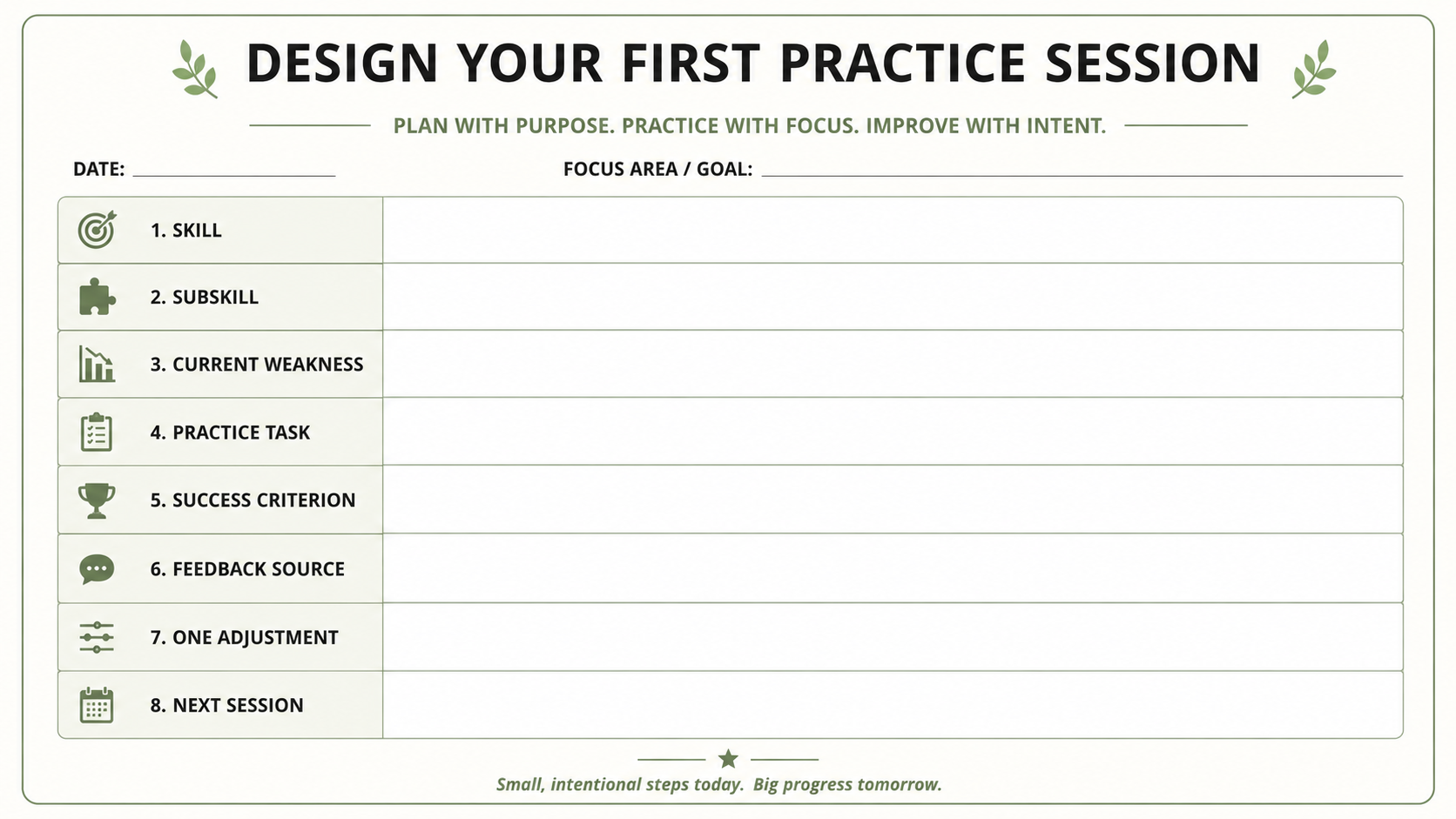
Plan one focused, feedback-driven practice session with this free printable worksheet.
How Long Should Deliberate Practice Last?
There is no universal session length.
A beginner may gain more from a concentrated 20- or 30-minute session than from two unfocused hours.
Someone with extensive training may sustain high-quality practice longer, but attention and feedback quality still deteriorate.
A practical starting point for demanding knowledge work is:
- 30–60 minutes
- One narrowly defined target
- Several short attempts
- A brief review
- A written note for the next session
Stop when you are no longer able to notice errors or apply feedback effectively.
Exhaustion is not proof that the practice was productive.
Recovery matters because the purpose is to return capable of another high-quality session.
Make Time for Practice
Deliberate practice competes with delivery work, meetings, administration, family responsibilities, and recovery.
Do not leave it as an open-ended intention.
Give it a place on the calendar.
For example:
Thursday, 9:00–9:45 a.m.: Practice article openings. Draft ten versions, score them against the rubric, and rewrite the weakest two.
This is more useful than:
Work on writing skills.
The Ultimate Guide to Time Blocking explains how to protect practice without pretending the rest of the week will disappear.
Common Deliberate Practice Mistakes
Repeating the whole performance
Practicing the entire activity may conceal the specific weakness.
Better: Isolate one component.
Choosing a vague goal
“Become a better writer” does not tell you what to practice today.
Better: Define one observable improvement.
Practicing only what feels comfortable
Comfortable practice can maintain skill without extending it.
Better: Work just beyond your current reliable performance.
Treating effort as proof of improvement
A task can be exhausting without being well designed.
Better: Judge the session by feedback and adjustment, not discomfort.
Collecting feedback without using it
Advice does not improve performance by itself.
Better: Convert one piece of feedback into the next attempt.
Practicing for too long
As attention declines, repetitions may become less useful.
Better: End while you can still evaluate and adjust.
Confusing deep work with deliberate practice
Deep work is sustained concentration on demanding work.
Deliberate practice is structured improvement of a skill through targeted tasks and feedback.
You can perform deep work without practicing a skill, and you can use deep work to create the concentration needed for deliberate practice.
Treating expertise as guaranteed
Practice matters, but it does not operate independently of coaching, health, opportunity, resources, prior knowledge, ability, and the field itself.
Better: Use deliberate practice as a strong improvement method, not as a promise.
Frequently Asked Questions
Structured practice appears important in many developed skill domains, but researchers disagree about whether it is always necessary and how much of expert performance it explains.
It is safer to say that high-quality practice is a major contributor rather than the sole cause of expertise.
No.
Practice quality and quantity matter, but other factors can influence performance, including instruction, opportunity, physical and cognitive characteristics, environment, health, and access to resources.
In Ericsson’s stricter definition, a qualified teacher or coach plays a central role in designing tasks and providing feedback.
Without that structure, you can still use purposeful-practice principles and build useful feedback loops.
It is usually demanding because it focuses on weaknesses and requires full attention.
That does not mean it must be painful or miserable. A person can value or even enjoy the improvement process while still finding the practice effortful.
A habit makes behavior more automatic.
Deliberate practice prevents performance from becoming completely automatic by directing attention to what still needs improvement.
Habits can help you show up consistently. Deliberate practice determines what you do after you arrive.
Deep work protects concentration.
Deliberate practice uses concentration for a specific improvement exercise with feedback and adjustment.
No universal number guarantees mastery.
The required time varies by skill, learner, training quality, standard of performance, and other conditions.
Yes, but it may be more accurate to call much of it purposeful practice because many knowledge-work fields lack standardized training systems and objective performance measures.
Writers, strategists, educators, consultants, designers, and managers can still isolate subskills, define standards, collect feedback, and improve through repeated adjustment.
Improvement Comes From the Loop
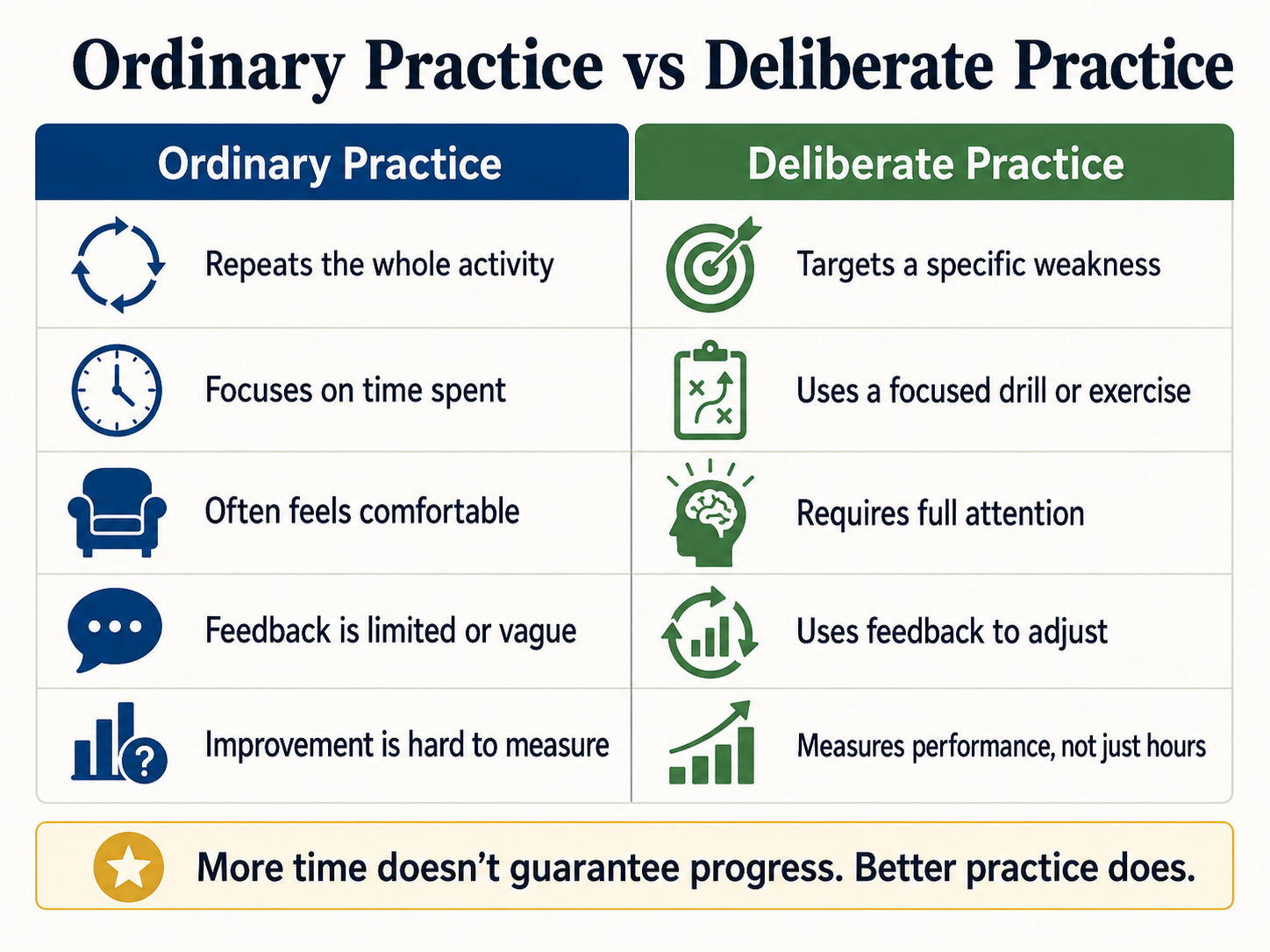
Ordinary practice asks:
How many times have I done this?
Deliberate practice asks:
What am I trying to improve, what did the feedback show, and what will I change on the next attempt?
That is the difference between repetition and refinement.
Choose one weakness.
Design one short exercise.
Find one useful source of feedback.
Make one adjustment.
Repeat.
Continue Learning
Explore Deliberate Practice Examples for practical applications in writing, knowledge work, teaching, and entrepreneurship.
See The Best Books on Deliberate Practice for deeper reading on expertise and performance.
Read the Deep Work Book Summary to understand how concentrated work can create the conditions for demanding practice.
Visit the Better Work hub for more resources on focus, learning, planning, and sustainable performance.
Improve the System, One Week at a Time
The Weekly Signal is a short weekly note for better work, clearer thinking, and practical systems you can actually use.
Selected Research
Ericsson, Krampe, and Tesch-Römer introduced the deliberate-practice framework in their 1993 research on expert performance.
Ericsson and Harwell later argued that the original definition should remain narrow and should distinguish deliberate practice from broader purposeful practice.
Campitelli and Gobet concluded that abundant deliberate practice may be necessary in chess but is not sufficient by itself to explain expert performance.
Macnamara and colleagues found that accumulated practice explained part, but not all, of performance differences across several fields.
Hambrick and colleagues challenged parts of Ericsson’s framework and argued that the definition and explanatory power of deliberate practice remain scientifically contested.