The planning fallacy is the tendency to make overly optimistic predictions about when work will be finished, even when similar tasks have taken longer before. To estimate better, start with comparable completed work, account for everything the task requires, and check how much time you can actually give it.
A report that “should take an afternoon” can occupy several days once you include finding the data, resolving an inconsistency, waiting for feedback, and making corrections. A more detailed to-do list helps only if it includes those parts and is grounded in experience.
This guide gives you a six-step estimation process and a worked example. The free PDF and editable Word worksheet let you try it on one task, then compare the forecast with what happened.
The central distinction
Effort is the time you actively work. Elapsed time includes waiting and the gaps between work sessions. Capacity is the time you can genuinely make available. A realistic completion date needs all three.
What the planning fallacy looks like
An optimistic estimate often describes a smooth sequence: open the file, do the work, send it. The real task includes getting started, clarifying requirements, checking the result, and fitting it around other commitments.
- A student allows one evening for an assignment because writing the answer seems straightforward, leaving out reading and checking references.
- A consultant estimates a workshop from its delivery time, overlooking preparation and follow-up.
- A team predicts a quick website update, assuming the reviewer and required assets will be available immediately.
These are illustrative examples, not evidence that every missed deadline is a bias. A new requirement, an outage, an illness, or a genuinely unusual problem can invalidate a reasonable forecast. Separate an inaccurate initial estimate from a task that changed after you estimated it.
Why knowing the past is not always enough
In Buehler, Griffin and Ross’s 1994 research, people made optimistic completion predictions for academic and everyday tasks. Their accounts of estimating emphasized future plans rather than relevant past experience. In one study, explicitly connecting past experience to the current prediction eliminated the optimistic bias in that condition.
The practical lesson is to make the connection visible. “Last time was different” may be true, but it needs an explanation. If interruptions, revisions, and missing information recur, excluding them from every forecast treats ordinary work as an exception.
The paper also cautions that reducing average optimistic bias did not improve absolute prediction accuracy in these studies. Simply remembering the past is not enough if the memories are inaccurate or the tasks are poorly matched.
This research does not establish a universal correction factor. The worksheet below is a practical way to apply an evidence-first approach, not a validated test or a promise that every estimate will be accurate.
Keep effort, elapsed time, and capacity separate
| Measure | What to record | Example |
|---|---|---|
| Active effort | Your working time on the defined task. | 7.5 hours of analysis, writing, and checks. |
| Elapsed time | Start to finish, including waits and gaps. | A task started Monday may finish the following Monday. |
| Available capacity | Work time you can realistically allocate. | Two usable hours per day after existing commitments. |
Dividing effort by daily capacity gives an initial number of working days. It does not automatically give the finish date. Dependencies may occur between stages; weekends, unavailable reviewers, and the timing of your work blocks still matter.
For client work, plan the full engagement workload, including preparation, delivery, revision, and follow-up. Otherwise a realistic estimate for one visible activity can still sit inside an unrealistic weekly plan.
A six-step process for estimating task time
1. Define what finished means
Write one observable output and the checks it must pass. “Work on the report” has no stable boundary. “A two-page recommendation with three checked findings, one review round, and an editable final file” can be estimated.
List important exclusions too. If a slide deck, new survey, or extra review round is outside the scope, say so. When the output changes, update the estimate rather than quietly judging the original estimate against different work.
2. Find comparable completed tasks
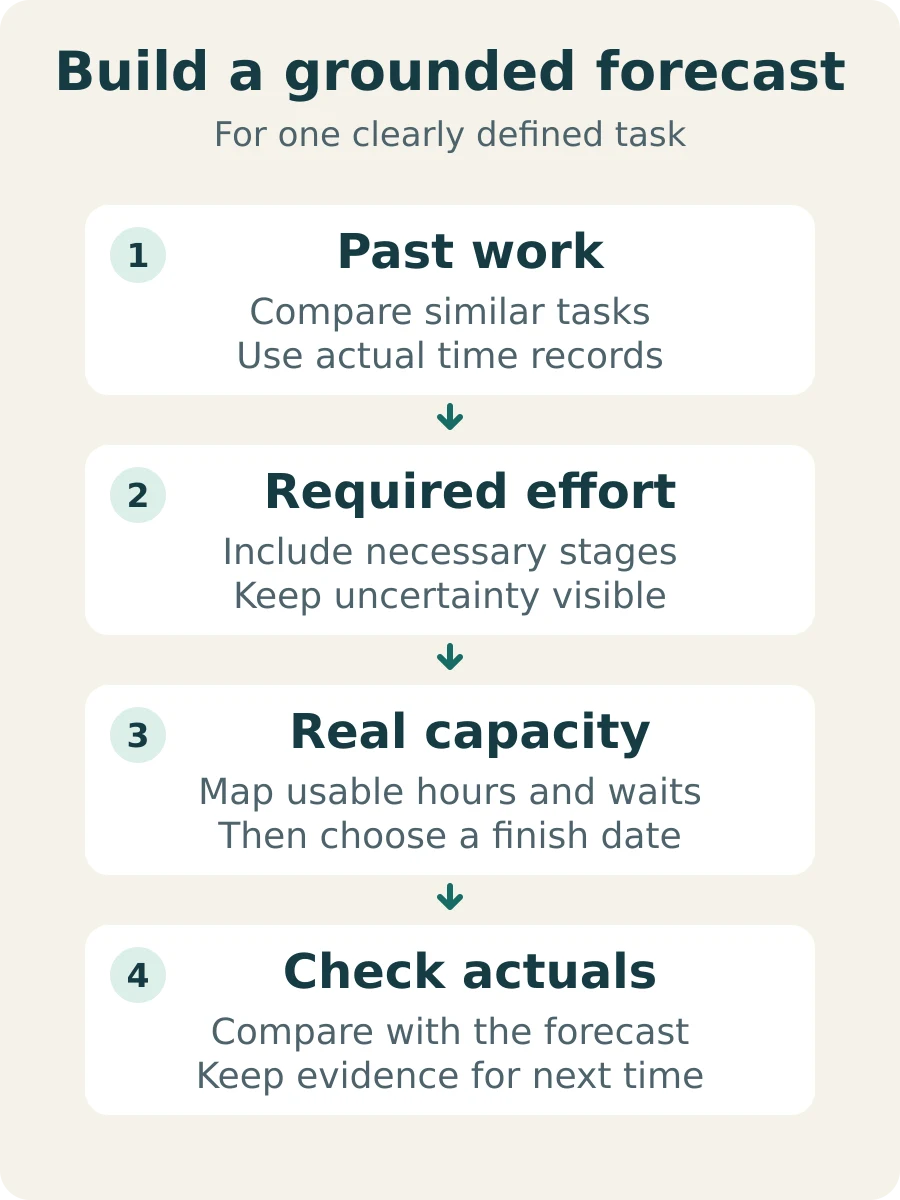
Look for recent tasks with similar size, familiarity, tools, quality requirements, and review needs. Three examples are a useful starting point for this worksheet; they are not a statistically reliable reference class by themselves. Use more relevant records when available.
Record actual effort and elapsed time separately. A calendar entry shows reserved time, not necessarily time spent. Use time records, saved versions, delivery dates, and brief notes to reconstruct the work. If you only remember a rough amount, label it an estimate.
Keep the slow example unless there is a specific reason it cannot apply. Choosing only your fastest previous task builds optimism into the evidence. If one task had a genuinely different scope, retain it as a separate case rather than blending it into the same average.
3. Adjust for explicit differences
Start from the typical result and the spread of those examples. Then ask what is observably different this time. A reusable template may remove formatting work. A new dataset may add validation. A new reviewer may introduce an uncertain waiting period.
Write each adjustment and its reason. “I will focus harder” is a weaker basis than “the verified data table already exists.” Avoid subtracting the benefit of a tool until you have evidence it helps with this particular task.
4. Break the task into necessary stages
Use a short breakdown to check for omissions: inputs, production, verification, revision, and handoff. Estimate ranges for uncertain stages. Include the work needed to answer questions and resolve errors, rather than treating checking as optional polish.
Compare the total with your past-task baseline. If the breakdown is much smaller, investigate the gap. You may have missed setup or revision work. Do not average two conflicting estimates without understanding why they disagree.
Avoid counting the same allowance twice. If comparable task totals already include routine revisions, adding a second full revision allowance requires a reason. Likewise, a named uncertainty allowance should not quietly reappear in every stage.
5. Map dependencies and real capacity
Identify what must happen before each stage can begin. Who supplies an input? Who reviews the draft? When are they available? Record waiting separately from your active work, and distinguish waits that overlap other work from waits that block the next step.
Place the effort into real openings after meetings, routine work, breaks, and existing commitments. If your estimate needs eight hours and the week offers four, the task does not fit unchanged. Discuss scope, date, or support; shrinking the estimate does not create capacity.
Choose a working range and a review point. The range expresses current uncertainty, not a statistical confidence interval unless you have actually calculated one. State any assumption that could change the finish date and arrange to revisit it before the deadline.
6. Compare the forecast with the actual result
Keep the original forecast. After finishing, record actual effort, elapsed time, scope changes, and the main reason for any difference. This creates better comparables for the next task.
For a simple calibration check, divide actual effort by the central effort estimate. A result above 1 means more effort than forecast; below 1 means less. Compare like with like: do not divide elapsed days by active hours or mix expanded scope into the original task without a note.
Look for patterns across similar work. Repeated missing review time calls for a better review estimate. One exceptional outage calls for a risk note. Neither automatically justifies doubling every future task.
Worked example: estimating a short report
Here is a fictional example. Maya needs a two-page internal recommendation using existing data, three checked findings, and one review round. A presentation and new interviews are outside scope.
Her last three similar reports took 5, 6, and 7 active hours. Their elapsed times were 3, 4, and 5 working days. Those totals included one revision round. The current report needs an unfamiliar data check, so she allows 1–2 extra active hours. That gives an initial effort range of 6–9 hours.
| Stage | Effort range | What is included |
|---|---|---|
| Check inputs | 1–1.5 hours | Confirm definitions and investigate inconsistencies. |
| Analyze findings | 2–3 hours | Compare results and select three supported findings. |
| Write the draft | 2–3 hours | Build the recommendation and evidence summary. |
| Review and finalize | 1–1.5 hours | Read feedback, correct the report, and check the final file. |
The breakdown also totals 6–9 hours. She uses 7.5 hours as a central planning estimate, while keeping the range visible. That midpoint is a convenient working value for this example, not a calculated expected value or guarantee.
Maya has two usable hours each working day. The central estimate represents nearly four days of capacity, but the reviewer cannot start until the draft exists. Under her working plan, the draft goes out Thursday morning; the reviewer needs two working days, so she reserves finalization capacity the following Monday. She checks that timing with the reviewer before treating Monday as a commitment.
Her contingency is specific: if the data cannot be validated in the first block, she flags the missing input and revisits the forecast. If review takes longer, she updates the delivery date. She does not hide both risks inside a mysterious “extra 30 percent.”
In the fictional outcome, the scope stays unchanged and the report takes 8 active hours, finishing the following Monday. The effort ratio is 8 ÷ 7.5 = about 1.07. The result sits inside the forecast range. Maya notes that data validation used the high end of its allowance and adds this report to her records.
What if you have no comparable tasks?
Treat the first estimate as provisional. Find the closest relevant example, identify what does not transfer, and ask someone experienced which stages beginners usually miss. Advice is more useful when it includes an actual completed task rather than another unsupported guess.
For unfamiliar work, first estimate a small discovery step: inspect the data, build one sample section, or test a key dependency. Use what you learn to revise the remaining forecast. If you cannot responsibly predict the whole task yet, communicate that uncertainty and the next point at which you can narrow it.
For high-consequence projects, a personal worksheet is only an input. Use the organization’s estimating, review, and risk-management processes. A handful of past tasks cannot establish a dependable probability of meeting a major commitment.
Planning fallacy versus Parkinson’s law
Planning fallacy concerns an optimistic forecast: you expect necessary work to take less time than it does. Parkinson’s law is the observation that work can expand into the time available, for example through optional elaboration. The two can appear in the same task.
Use past evidence to estimate the required work. Use an agreed scope and stopping condition to prevent unnecessary additions. Artificially shortening the deadline is not a substitute for either. An external review or essential check still takes the time it takes.
Download the task-estimation worksheet
The four-page tool includes two reusable blank pages and a completed version of Maya’s report example. Capture three comparables, scope adjustments, stage estimates, dependencies, capacity, and an actual-versus-estimate review. The PDF is for printing; the Word version is editable.
Use the free worksheet to turn past task evidence into a forecast you can review.
Choose one task you expect to finish soon. Before writing a new estimate, find one similar task you actually completed. The most useful question is: what happened last time that needs a place in this forecast?
Once the estimate is credible, the free 7-Day Time Blocking Reset can help you turn it into a workable weekly plan.