Consulting calendars often understate the real workload.
A one-hour client meeting may require preparation, document review, analysis, notes, follow-up, revisions, and changes to the next deliverable. A project that appears to need six hours may consume ten once all of the surrounding work is included.
When several clients create that hidden workload during the same week, the calendar can become overloaded before it looks full.
Time blocking for consultants means reserving calendar capacity for the complete workload of each engagement, including delivery, meetings, preparation, follow-up, administration, expected revisions, and normal variability.
Across consulting, training, legal advisory, and digital strategy work, I have found that the hardest weeks are not always those with the most visible appointments. They are the weeks in which the calendar records the meetings but fails to record the work those meetings create.
If you are new to the planning method itself, begin with my Ultimate Guide to Time Blocking. This guide focuses specifically on engagement capacity and managing several consulting clients within one realistic week.
Quick answer: To time block consulting work, calculate the full capacity cost of every active engagement, combine those estimates into one client portfolio, and compare the total with the hours you genuinely have available. Protect delivery blocks around fixed client commitments, schedule preparation and follow-up beside meetings, retain capacity for proposals and business development, and recalculate the week whenever scope changes.
The central principle is:
Schedule the workload around the engagement, not just the meeting.
Why Consultant Calendars Understate the Real Workload
Consulting work is rarely one continuous activity.
During the same day, you may need to:
- Analyze information for one client
- Prepare for another client’s meeting
- Join a workshop
- Document decisions
- Revise a deliverable
- Answer a scope question
- Write a proposal
- Handle invoicing or administration
Each item may be reasonable on its own.
The difficulty comes from the work surrounding each commitment and the mental transitions between different clients.
Research on task switching summarized by the American Psychological Association shows that moving between tasks creates switching costs. The mind must disengage from one goal and activate the information, rules, and context needed for another.
For consultants, those contexts may differ significantly.
One client may require organizational strategy. Another may need detailed implementation work. A third may require facilitation, research, legal analysis, or executive communication.
Five open 30-minute periods scattered between calls are therefore not always equivalent to one uninterrupted 2.5-hour delivery block.
Your consulting calendar may be understating the workload when:
- Meetings are recorded, but preparation and follow-up are not.
- Different clients occupy small pieces of every day.
- Important analysis moves into evenings.
- Revisions are treated as exceptions even though they occur regularly.
- Business development happens only when the pipeline becomes weak.
- Every client addition is absorbed without another commitment moving.
- You repeatedly plan the same client for fewer hours than the engagement actually consumes.
- The calendar appears open, but you still feel over capacity.
The solution is not merely to create more calendar blocks.
You first need to calculate what each engagement truly requires.
Step 1: Calculate the Full Capacity Cost of Each Engagement
Do not begin with the client meeting schedule.
Begin with the complete workload attached to each engagement.
Use this formula:
Engagement load = delivery + meetings + preparation + follow-up + administration + expected revisions + buffer
The categories will vary according to the type of consulting work, but the formula forces you to look beyond visible appointments.
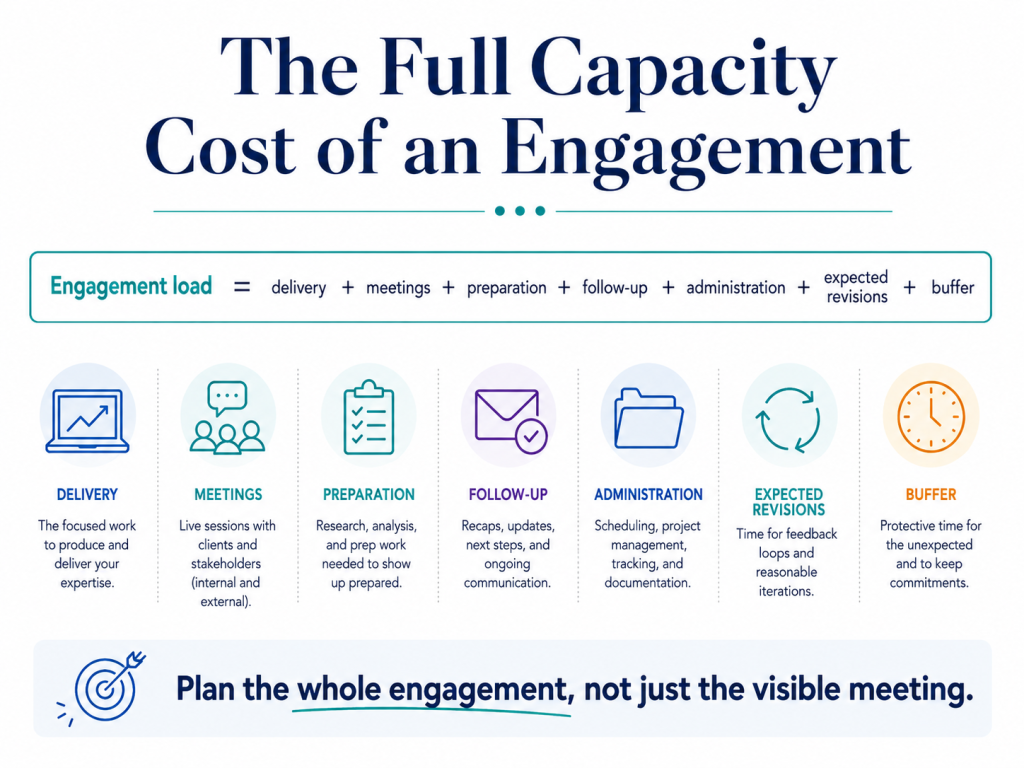
Delivery
This is the work required to produce the result the client expects.
Examples include:
- Research
- Analysis
- Recommendations
- Reports
- Presentations
- Workshop design
- Implementation support
- Documentation
- Reviewing results
- Creating or revising deliverables
Meetings
Include all synchronous client and stakeholder interactions.
Examples include:
- Discovery calls
- Status meetings
- Interviews
- Workshops
- Review sessions
- Decision meetings
- Executive briefings
Preparation
Include the work required before important interactions or delivery sessions.
Examples include:
- Reviewing documents
- Reading new data
- Preparing an agenda
- Organizing questions
- Updating materials
- Reviewing previous decisions
- Preparing recommendations
Follow-Up
Include the work created after a meeting or milestone.
Examples include:
- Writing notes
- Documenting decisions
- Sending next actions
- Updating the project plan
- Revising a deliverable
- Requesting missing information
- Clarifying responsibilities
Administration
Include the engagement-specific operating work.
Examples include:
- Scheduling
- Contract administration
- Time records
- File organization
- Invoicing
- Status reporting
- Project-management updates
Expected Revisions
Do not assume that every deliverable will be accepted without changes.
Use evidence from similar work to estimate a reasonable amount of revision capacity.
This is not permission for unlimited revisions. It is recognition that review and refinement are often part of consulting delivery.
Buffer
Reserve a modest amount of engagement capacity for normal uncertainty.
Possible causes include:
- Late information
- Stakeholder changes
- A meeting running long
- Additional clarification
- A task taking longer than estimated
- A technical problem
- A short unexpected request
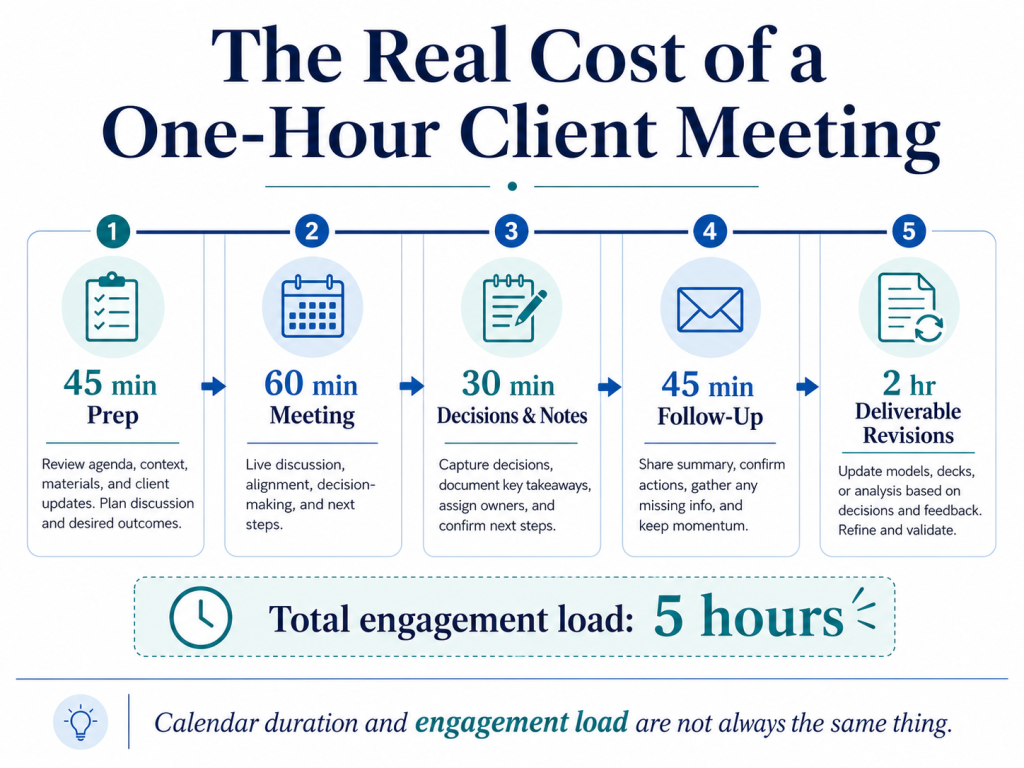
Example: The Real Cost of a One-Hour Client Meeting
Suppose your calendar shows:
Wednesday, 2:00 to 3:00 p.m.: Client strategy review
The visible commitment is one hour.
The full workload may be:
- 45 minutes reviewing data and preparing recommendations
- 60 minutes in the meeting
- 30 minutes documenting decisions
- 45 minutes communicating next actions
- 2 hours revising the deliverable
The engagement load created by that meeting is five hours, not one.
The numbers are illustrative. A routine check-in may require almost no preparation. An executive workshop may create several hours of work before and after it.
The important point is:
Calendar duration and engagement load are not always the same thing.
Step 2: Map Capacity Across All Active Clients
Calculating one engagement is not enough.
The next step is to combine every active client into one portfolio view.
Consultants often plan clients separately:
- Client A looks manageable.
- Client B looks manageable.
- Client C looks manageable.
The problem becomes visible only when all three are placed inside the same finite week.
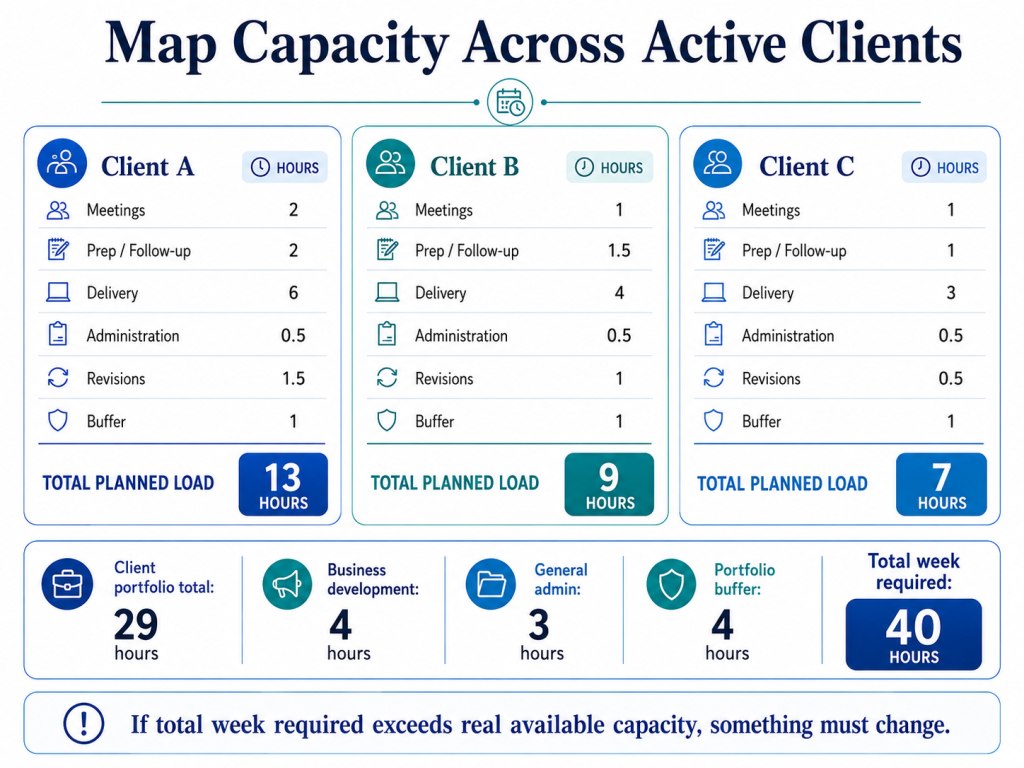
Create a Weekly Capacity Card for Each Client
For every active engagement, record:
- The next client outcome
- Fixed meetings
- Delivery blocks required
- Preparation time
- Follow-up time
- Administration
- Expected revisions
- Client dependencies
- The main uncertainty
- Buffer required
- Total planned engagement load
For example:
Client A
- Fixed meetings: 2 hours
- Preparation and follow-up: 2 hours
- Delivery: 6 hours
- Administration: 30 minutes
- Expected revisions: 1.5 hours
- Buffer: 1 hour
- Total planned load: 13 hours
Client B
- Fixed meetings: 1 hour
- Preparation and follow-up: 1.5 hours
- Delivery: 4 hours
- Administration: 30 minutes
- Expected revisions: 1 hour
- Buffer: 1 hour
- Total planned load: 9 hours
Client C
- Fixed meetings: 1 hour
- Preparation and follow-up: 1 hour
- Delivery: 3 hours
- Administration: 30 minutes
- Expected revisions: 30 minutes
- Buffer: 1 hour
- Total planned load: 7 hours
The three-client portfolio requires 29 hours.
Now add the work needed to operate and maintain the consulting practice:
- Business development: 4 hours
- General administration: 3 hours
- Portfolio buffer: 4 hours
The complete week requires 40 hours.
If your real available capacity is 35 hours, the portfolio does not fit.
That conclusion is more useful than trying to compress 40 hours of work into 35 and hoping every task takes less time than expected.
Decide What Changes Before Building the Calendar
When the portfolio exceeds capacity, use one or more of these options:
- Reduce the scope of a deliverable.
- Move a lower-priority milestone.
- Renegotiate a deadline.
- Delegate part of the work.
- Reduce meeting frequency.
- Replace a synchronous update with an asynchronous one.
- Decline or delay new work.
- Use approved additional paid capacity.
- Remove lower-value internal work.
Do not reduce every estimate until the total looks acceptable.
The purpose of capacity planning is to reveal the trade-off, not conceal it.
For the complete process of turning priorities, fixed commitments, and available capacity into a calendar, use How to Time Block Your Week.
Step 3: Protect Delivery Blocks Around Client Constraints
Client commitments shape the week.
You may not control:
- Executive availability
- Workshop dates
- Stakeholder schedules
- Time zones
- Reporting deadlines
- Review cycles
- Client decision windows
But you can protect meaningful delivery periods around those constraints.
Place Fixed Client Commitments First
Add confirmed meetings, workshops, reviews, and deadlines to the calendar.
Then examine the remaining space.
Do not assume every gap is suitable for demanding work.
A 45-minute opening between two calls may work for routine communication. It may not be enough for strategic analysis or writing.
Protect Larger Delivery Blocks
Identify the work that requires sustained concentration.
Examples include:
- Synthesizing interviews
- Analyzing data
- Developing recommendations
- Writing a report
- Creating a workshop
- Diagnosing a process
- Reviewing legal or policy materials
- Building an implementation plan
Assign these activities blocks long enough to produce meaningful progress.
Avoid:
Client A work
Use:
Client A: Review 12 stakeholder interviews and identify the five recurring barriers.
Avoid:
Finish presentation
Use:
Draft slides 8 to 15 covering findings, implications, and three recommendations.
A defined outcome reduces the decision required when the block begins.
Cluster Meetings Where Practical
Meeting clustering can preserve larger areas of the week for delivery.
Microsoft workplace data found that half of meetings occurred between 9 and 11 a.m. and between 1 and 3 p.m., periods that may otherwise support focused work for many people.
The practical lesson is not that consultants should refuse meetings during those hours.
It is that leaving the entire week available for client booking can allow meetings to occupy every useful concentration period.
Where client conditions permit, create defined meeting windows such as:
- Tuesday afternoon
- Thursday late morning and afternoon
- Friday late morning for short follow-up calls
Keep exceptions for workshops, time-zone constraints, client-critical decisions, and high-value opportunities.
For ready-made freelance and meeting-heavy consultant schedules, see the Time Blocking Templates for Freelancers. This guide goes deeper into calculating and managing the full capacity cost of each consulting engagement.
Step 4: Schedule the Work Surrounding Meetings
A meeting should not sit alone on the calendar when it predictably creates work before and after it.
Microsoft’s guidance on more intentional meetings treats preparation, agendas, summaries, action items, and follow-up as parts of the broader meeting process.
Your consulting calendar should do the same.
Instead of:
2:00 to 3:00: Client review
Use:
1:30 to 2:00: Prepare
Review the latest metrics and confirm the three decisions required.
2:00 to 3:00: Client review
3:00 to 3:30: Follow-up
Capture decisions, send next actions, and update the delivery plan.
The visible one-hour appointment now occupies two hours of real capacity.
That may make the calendar appear less efficient.
It is actually more accurate.
Match the Surrounding Time to the Meeting
Not every meeting requires the same amount of preparation and follow-up.
A routine 15-minute status call may need only a few minutes.
A two-hour strategic workshop may require:
- Several hours of preparation
- Stakeholder research
- Customized materials
- Facilitation planning
- Detailed notes
- Deliverable revisions
Estimate based on the engagement rather than applying a universal meeting ratio.
Place Follow-Up Close to the Meeting
When possible, capture decisions and next actions immediately after the interaction.
Delaying follow-up can create several problems:
- Details become less clear.
- Commitments remain undocumented.
- The client may not know what happens next.
- Notes accumulate into a larger administrative backlog.
- Revisions begin without a confirmed decision record.
Even a short protected follow-up block can reduce that friction.
Step 5: When Scope Changes, Recalculate Capacity
Consulting engagements change.
A client may request:
- An additional analysis
- A new stakeholder interview
- Another workshop
- A revised report
- A shorter deadline
- More implementation support
- A new presentation
- Additional rounds of review
A change is not automatically scope creep.
Scope changes can be valid and valuable when they are recognized, evaluated, approved, and incorporated into the plan.
PMI guidance on scope change control emphasizes evaluating how a requested change affects the project’s schedule, cost, resources, and expectations before updating the plan.
For consultants, that means a scope addition should trigger a capacity recalculation.
Recalculate the Engagement Load
When a new request arrives, ask:
- What new output is required?
- How much delivery work will it create?
- Does it require another meeting?
- What preparation and follow-up will be needed?
- Will it create additional revisions?
- What existing block will move?
- Does the deadline need to change?
- Does the fee or scope agreement need to change?
- Who needs to approve the change?
Then update the engagement capacity card and the total portfolio.
Use this rule:
New work should replace capacity before it adds capacity.
Trade Instead of Stack
Suppose a client requests three additional hours of analysis by Thursday.
Do not automatically add:
Wednesday, 7:00 to 10:00 p.m.: Additional client analysis
First decide:
- Which existing block will move?
- Can part of the request wait?
- Can another deadline change?
- Can the work be reduced or divided?
- Is there enough approved buffer?
- Does the client need a revised estimate?
If the request is genuinely urgent, it may displace something else.
The displacement should be visible.
Otherwise, new work appears to cost nothing.
Separate Urgency From Client Pressure
A client is waiting, but that does not make every request equally urgent.
A genuine urgent issue might involve:
- A critical deadline
- A legal or compliance risk
- A failed system
- A significant client decision
- Work blocking several stakeholders
- Immediate financial consequences
Other requests may be important but schedulable.
When the distinction is unclear, use the Eisenhower Matrix to decide whether the work requires immediate attention, deliberate scheduling, delegation, or renegotiation.
Responsiveness matters.
So does accurate prioritization.
Step 6: Protect Pipeline Capacity Without Maximizing Utilization
Consultants can fall into a predictable cycle:
- The pipeline fills.
- Client delivery becomes busy.
- Business development stops.
- Current projects finish.
- The pipeline weakens.
- Selling suddenly becomes urgent.
A calendar optimized only for current billable work can create a future revenue problem.
Professional-services organizations distinguish billable utilization from broader productive capacity. Kantata’s definition of total utilization includes productive work such as business development and proposal writing, even when those hours are not billed to a current client.
For an independent consultant, that means nonbillable does not automatically mean unproductive.
Useful pipeline work may include:
- Following up with former clients
- Developing referral relationships
- Writing a proposal
- Reconnecting with dormant prospects
- Publishing a useful insight
- Building a case study
- Conducting discovery conversations
- Reviewing open opportunities
- Improving an offer
Protect recurring pipeline capacity even during busy delivery periods.
Current clients create today’s revenue. Business-development blocks protect tomorrow’s pipeline.
Give the Block a Concrete Output
Avoid:
Business development
Use:
Follow up with three former clients and contact two referral partners.
Avoid:
Marketing
Use:
Draft one case study showing the result of the recent adoption project.
The block should specify what will exist or what action will be completed.
Do Not Chase a Universal Utilization Target
There is no single billable percentage that suits every consultant.
The right balance depends on:
- Service model
- Role and seniority
- Engagement length
- Sales cycle
- Pipeline strength
- Administrative support
- Learning requirements
- Personal capacity
- Revenue goals
A solo consultant who handles sales, delivery, administration, and relationship management cannot treat every nonbillable hour as waste.
If consulting is only one part of a broader business that also includes employees, products, operations, and strategic ownership, use the role-based framework in Time Blocking for Entrepreneurs.
Step 7: Reserve Buffer Across the Client Portfolio
Consulting depends on other people, information, approvals, and decisions.
That creates normal uncertainty.
Possible disruptions include:
- Client data arriving late
- A stakeholder becoming unavailable
- Additional reviewers joining
- A deliverable receiving more feedback than expected
- A workshop running long
- A decision being delayed
- A new executive request
- A technical problem
- A task taking longer than estimated
- A client needing urgent clarification
A consulting calendar with no buffer assumes that every engagement will behave exactly as planned.
That assumption is rarely realistic.
Use Engagement Buffer
Include a modest amount of variability inside the estimate for each client.
This is useful when an engagement regularly involves:
- Revisions
- Data questions
- Client coordination
- Short overruns
- Clarification
- Routine uncertainty
Do not hide large amounts of unexamined padding inside every estimate.
The buffer should reflect evidence from similar work.
Use Portfolio Buffer
Keep some weekly capacity unassigned to a specific client.
This protects the overall portfolio when one engagement creates an unexpected need.
For example:
Thursday, 3:30 to 5:00: Portfolio buffer
If no client issue requires the block, use it for:
- Finishing priority delivery work
- Business development
- Documentation
- Process improvement
- Recovery
Identify a Recovery Block
Know which period can restore important work displaced earlier in the week.
A recovery block should not become an automatic extension of every project.
It is a deliberate place to restore high-value work when a legitimate disruption consumes the original block.
If the current week is already overloaded and disconnected from the original plan, use The Time Blocking Reset to rebuild the remaining days rather than abandoning the calendar.
Step 8: Review Planned Versus Actual Capacity by Client
The consultant weekly review should examine more than whether the deliverables were completed.
It should compare what each engagement was expected to consume with what it actually consumed.
Deltek’s 2026 professional-services benchmark research tracks measures including consultant utilization and project overruns. Its broader lesson is that capacity, estimation, delivery, and financial performance are connected.
An independent consultant can apply that principle without an enterprise reporting system.
Review Each Active Client
Record:
- Planned total hours
- Actual total hours
- Meeting time
- Preparation time
- Follow-up time
- Delivery time
- Revision time
- Administration
- Unplanned requests
- Approved scope changes
- Work moved into evenings
- Capacity required next week
Then examine the variance.
Ask What Caused the Difference
A client may have consumed more capacity because:
- The original estimate was too low.
- The meeting workload was underestimated.
- More stakeholders became involved.
- Information arrived late.
- The client added work.
- The consultant added unrequested work.
- Revisions exceeded the agreed process.
- Too much switching reduced delivery efficiency.
- The engagement lacks a clear decision process.
- Administration was never included in the estimate.
Different causes require different corrections.
Do not respond to every overrun by simply adding more buffer.
The real correction may be:
- A better estimate
- Clearer scope
- Fewer meetings
- A different review process
- A revised fee
- More client preparation
- Better delegation
- A later deadline
- A more focused deliverable
Make Three Decisions for Next Week
End the review with:
- One engagement estimate to update
- One workload source to contain
- One pipeline action to protect
For example:
- Increase Client A’s preparation estimate by one hour.
- Limit Client B’s revisions to the agreed review process.
- Protect Wednesday afternoon for proposal development.
The review should improve next week’s assumptions.
It should not become a judgment about whether you worked hard enough.
Four Capacity Mistakes Consultants Should Avoid
Counting Meetings but Not Engagement Load
The calendar records the call but omits preparation, follow-up, and revisions.
Correction: Calculate the complete capacity cost of the engagement.
Planning Each Client Separately
Every engagement appears manageable when viewed alone, but the combined portfolio exceeds the week.
Correction: Add all client loads together before scheduling discretionary work.
Absorbing Changes Without Recalculating
New client requests enter the week without deadlines, fees, or other commitments changing.
Correction: Update the engagement load and make the trade-off visible.
Tracking Billable Hours but Ignoring Variance
You know how much time was billed, but not why a client required more work than planned.
Correction: Compare planned and actual capacity, including preparation, follow-up, revisions, and unplanned requests.
Frequently Asked Questions
How Do I Calculate the Real Workload of a Consulting Engagement?
Add the time required for delivery, meetings, preparation, follow-up, administration, expected revisions, and reasonable buffer.
Use evidence from similar engagements rather than estimating only the visible meeting and deliverable hours.
How Should Consultants Time Block Multiple Clients?
Calculate the weekly load of each engagement first.
Combine the estimates into one portfolio, add business development, administration, and general buffer, and compare the total with your actual available capacity.
Then protect delivery blocks for the highest-priority outcomes and place fixed client commitments around them.
How Much Preparation Time Should I Schedule Around Meetings?
There is no universal ratio.
A routine check-in may require very little preparation. A strategic workshop may require several hours.
Estimate according to:
Meeting purpose
Participants
Information required
Decisions needed
Materials to prepare
Likely follow-up
Expected deliverable changes
Review actual preparation time afterward and adjust future estimates.
How Should I Handle an Urgent Client Request?
First determine whether the request is genuinely urgent and whether it is within the agreed scope.
Then estimate its complete capacity cost.
Use approved buffer when possible. If the request requires more capacity, decide which existing work will move or whether the deadline, scope, or fee needs to change.
Do not assume that urgent work must automatically extend your working day.
How Do I Know Whether I Have Capacity for Another Client?
Estimate the new engagement’s complete weekly load, including meetings, preparation, follow-up, delivery, administration, revisions, and buffer.
Add that number to the current portfolio.
Also include business development, general administration, and recovery capacity.
If the total exceeds your real availability, you do not currently have capacity unless something changes.
Should Consultants Maximize Billable Utilization?
No.
Billable work matters, but consultants also need capacity for:
Proposals
Relationship development
Administration
Learning
Practice improvement
Unexpected client needs
Rest and recovery
The correct balance depends on the consulting model, pipeline, engagement mix, financial needs, and personal capacity.
What If Clients Expect Continuous Availability?
Clarify response expectations instead of assuming that every message requires an immediate reply.
Some engagements genuinely require high availability. Others simply lack agreed communication norms.
Define:
Normal response times
Meeting windows
Escalation channels
What qualifies as urgent
Who can make decisions
When additional availability changes the scope or fee
Predictable communication can preserve client trust without allowing routine messages to fragment every delivery block.
Build a Consulting Week That Reflects the Real Work
Time blocking for consultants is not primarily about creating an attractive calendar.
It is about making the workload visible before you commit to it.
A realistic consulting week recognizes that:
- Meetings create work before and after them.
- Different clients create switching costs.
- Engagements must be evaluated as part of one portfolio.
- Scope changes affect time and delivery capacity.
- Business development deserves productive capacity.
- Client uncertainty requires buffer.
- Planned and actual workload should inform the next estimate.
The most important shift is:
Schedule the workload around the engagement, not just the meeting.
Start by choosing one active client.
Calculate:
- Delivery
- Meetings
- Preparation
- Follow-up
- Administration
- Expected revisions
- Buffer
Then compare the total with the hours currently reserved for that client.
The difference is where a more realistic consulting week begins.
Turn Engagement Capacity Into a Repeatable Weekly System
Time Blocking OS helps you turn real capacity, client commitments, priorities, and buffer into a weekly planning system you can review and adjust.
Use it to protect delivery work, preserve pipeline capacity, and decide what moves when client conditions change.
If your current schedule is already overloaded or repeatedly collapsing, begin with the free 7-Day Time Blocking Reset and rebuild from the week you actually have.