Kaizen in daily life means improving an everyday process through observation, a small change, and a review of what happened. You might make leaving the house less rushed, reduce the effort of starting work,
or simplify how you handle household paperwork.
Start with one recurring frustration. Notice what causes it, test one adjustment, and check whether life becomes easier. Keep what helps and revise what does not.
That gives personal development a concrete place to begin. Instead of committing to a complete life overhaul, you work on a situation you can observe and influence this week.
What does personal Kaizen mean?
Kaizen is commonly associated with continuous improvement in organizations. Its application extends beyond work: Kaizen Institute’s definition includes personal, home, and social life.
For an individual, the useful question is: Which part of this routine could work better, and how will I know?
Suppose mornings repeatedly feel rushed. “Become more organized” is too broad to test. “Put tomorrow’s bag and keys in one place after dinner” gives you something specific to try. Over the next few mornings, you can see whether searching for things becomes less frequent.
Small changes are a manageable starting point. Their value depends on whether they solve a real problem. A tiny adjustment that adds another obligation without helping is still worth reconsidering.
This guide adapts continuous-improvement principles to ordinary personal routines. For organizational applications, see these practical Kaizen examples for the workplace.
How to apply Kaizen to daily life
One useful structure is the Plan–Do–Check–Act (PDCA) cycle. ASQ describes
PDCA as a repeating method for planning a change, testing it, reviewing the results, and acting on what you learn.
Before planning, observe the routine as it currently happens. Then use the four steps below. The weekly timing is a practical starting suggestion; some changes need a longer test.
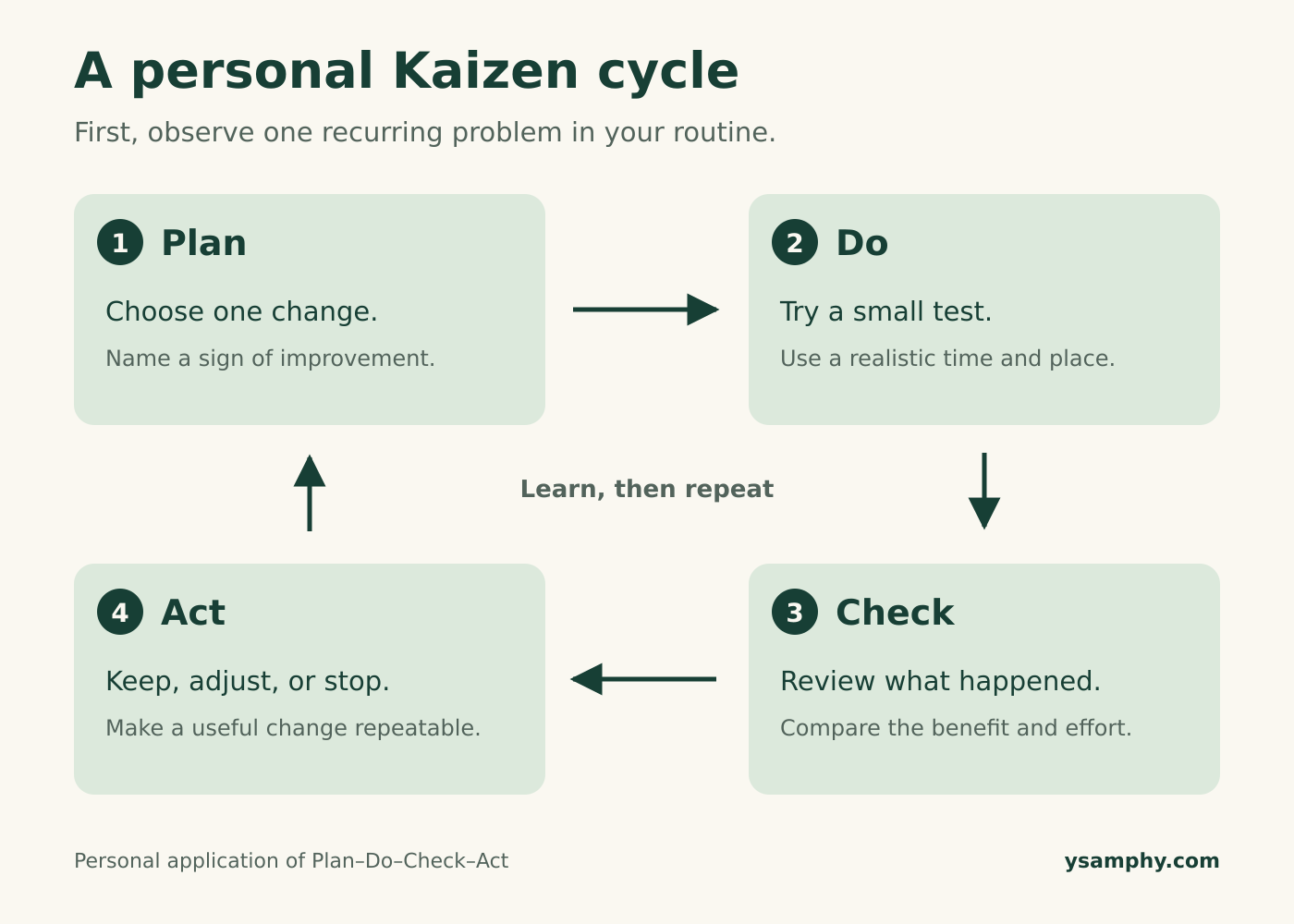
Observe a recurring problem, then use a simple cycle to test an improvement. This graphic is a personal application of PDCA.
1. Plan one change around a specific problem
Choose a problem that happens often enough to notice. Write it in observable terms: “I spend time finding the right document before each call,” rather than “I am bad at preparing.”
Look at the circumstances. Is the file stored in several places? Does the calendar invitation lack a link? Does preparation depend on remembering something at the busiest moment?
Choose one change and one sign of improvement. For example: add a document link to each meeting invitation and note whether you still need to search when the call begins.
2. Do a small test
Try the change in a limited setting: your next three calls, the next five school mornings, or one week of dinner planning.
Keep the rest of the routine reasonably similar where possible. Changing the storage system, calendar, and preparation checklist together makes it harder to understand which adjustment helped.
The test should fit your actual capacity. If setting it up takes more effort than the original problem, simplify it before proceeding.
3. Check the result and the effort
At the end of the test, compare what happened with your starting observation. Did you search less, start more easily, miss fewer details, or feel less rushed?
Check the cost too. Preparing everything at night may help the morning but create an exhausting evening. A useful improvement should make sense across the routine, including the work it creates for someone else.
A short test provides clues, not proof. If an unusually quiet week made the change easy, try it during a more typical week before treating it as reliable.
4. Act on what you learned
Choose one of three actions:
- Keep it: make the helpful change your normal
setup. - Adjust it: change the timing, scope, or method and test again.
- Stop it: drop an experiment whose benefit does not justify its effort.
When you keep a change, make the next repetition easier. Put the tray where keys actually land, save the meeting template, or attach the checklist to the place where you use it.
You can leave a working routine alone. Continuous improvement does not require constant tinkering.
7 practical Kaizen examples in daily life
These are illustrative scenarios you can adapt, rather than reported case studies. Choose the one closest to a problem you already
experience.
1. Make leaving the house less rushed
Problem: departure is repeatedly delayed by searching for keys, bags, or an essential item.
Small test: put the items that regularly go missing in one departure spot. Prepare them at a point in the evening when you still have enough energy.
What to check: on five comparable mornings, note whether you needed a last-minute search. Also notice whether the evening
preparation was manageable.
If the spot is too far from where you naturally leave things, move it. If other people share the routine, agree on the setup together.
2. Reduce the effort of starting focused work
Problem: the first few minutes of a work session disappear into deciding where to begin.
Small test: before finishing a session, leave a short note naming the next action: “Draft the opening paragraph” or “Check the totals in the second table.”
What to check: during the next few sessions, observe whether the note helps you begin without rebuilding the context.
If the action is still vague, make it more specific. You can place it beside a planned work block using daily and
weekly time blocking.
3. Make a reading routine easier to begin
Problem: you intend to read, but choosing a book or finding it becomes another decision at the end of the day.
Small test: choose one book in advance and put it beside a place where you already sit. Try a brief reading session at a realistic moment.
What to check: record whether you began and whether the timing suited you. Page count is optional; getting a usable routine is the first question.
For more on reducing the size of the starting action, read how baby steps lead to big changes. Here, the Kaizen test also checks the setup and revises it based on what happened.
4. Simplify household paperwork
Problem: bills, school forms, and letters accumulate in different places, making the next action unclear.
Small test: use one clearly marked place for incoming paperwork and a short, scheduled review. At that review, give each item a next action, date, or filing destination.
What to check: after a week, see whether fewer items are misplaced and whether urgent papers are easy to identify.
Handle time-sensitive documents when they arrive; a weekly review should not delay an earlier deadline. If the pile keeps growing, shorten the review interval or simplify the sorting categories.
5. Reduce repeated decisions about dinner
Problem: choosing dinner from scratch every evening adds effort when everyone is already tired.
Small test: choose two familiar meals before shopping and keep their ingredients available. Leave other evenings flexible.
What to check: notice whether those meals reduce last-minute decisions, use ingredients you already have, and fit the household’s preferences.
If the plan creates unused food or too much preparation, change the meals or reduce the quantity. The point is a more workable evening routine, not a perfect meal calendar.
6. Find digital files more easily
Problem: you repeatedly search several folders for current documents.
Small test: choose one active project and use one folder with a simple naming rule, such as “Project–Document–Date.” Keep your original files until you have checked the new arrangement.
What to check: during normal use, note whether you can identify and open the current file without checking several versions.
If the rule takes too much thought, simplify it. A modest system that you use consistently is easier to maintain than a complex structure you abandon.
7. Make a recurring family handoff clearer
Problem: an errand or pickup requires repeated messages because the time, person, or next step is unclear.
Small test: agree on one shared place to record who is doing what and when. Begin with one recurring handoff rather than reorganizing the whole household.
What to check: ask everyone involved whether the arrangement reduced confusion and whether updating it added reasonable effort.
If it shifts more work onto one person, revise the arrangement together. Shared routines need shared input.
A weekly personal Kaizen routine
A weekly review gives the experiment a decision point. It also prevents a new routine from continuing indefinitely just because you once decided to try it.
Here is a workable starting rhythm:
| When | What to do | What to write down |
|---|---|---|
| Before the test | Observe the current routine and choose one change | Problem, starting observation, change, and review date. |
| During the week | Try the change when the situation occurs. | One brief note about the result or a difficulty. |
| At the review | Compare the result and the effort. | Keep, adjust, or stop—and why. |
| Next week | Maintain the useful setup or test one revision. | The next action, if one is needed. |
Set aside about ten minutes for the review if that fits your schedule. The time limit is a practical suggestion, not a researched optimum.
Ask: What improved? What remained difficult? Was the benefit worth the effort? What will I do with the result?
A completed example
Suppose you noticed a search for keys or a bag on three of five school mornings. You test a departure spot and prepare the items after dinner. During the next five mornings, you need a last-minute search once.
That is a useful signal to investigate. Check whether departure was actually easier and whether the new evening task remained manageable. If so, keep the setup and observe it during another typical week. If preparing after dinner was difficult, test an earlier moment.
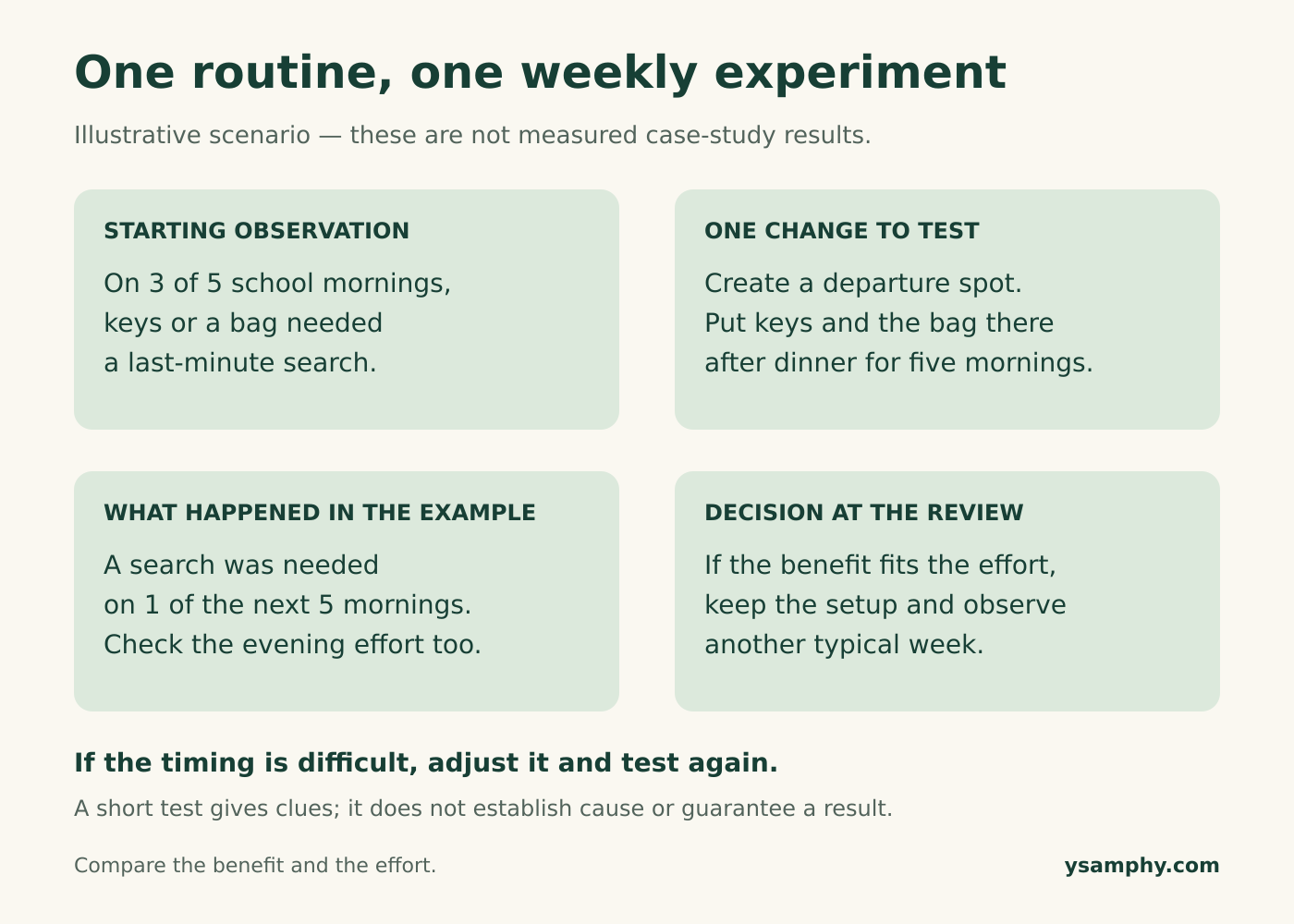
Illustrative figures only. This example shows how to review a change; it does not report a measured outcome or promise the same result.
Copy this personal Kaizen template
Use a notebook or a note on your phone. Keep the record short enough that you will actually use it.
Routine I want to improve:
What currently happens:
One change I will test:
When and where I will try it:
Sign of improvement:
Review date:
What happened, including the effort:
My decision – keep, adjust, or stop:
“Sign of improvement” can be a simple count, a shorter search, fewer reminders, or a shared observation that the routine felt easier. Choose something connected to the problem, rather than tracking everything you can count.
What to do when the experiment does not stick
If you miss the new action, look at the conditions before making a bigger commitment. Was the timing unrealistic? Was the item out of reach? Did the routine depend on a reminder you rarely see? Was the week unusually demanding?
Reduce the setup, change the timing, or pause the test until it can run under more representative conditions. Write down what interrupted it so you can use that information next time.
An experiment can also fail because it tackles the wrong cause. A better bag station will not fix a departure time that leaves no room for the household’s actual needs. In that case, revisit the underlying schedule.
Some constraints need a larger decision or additional support. Small routine changes have limits when the problem is an excessive workload, an unaffordable commitment, or a journey that consumes too much of the day. Recognizing that limit is part of reviewing the situation honestly.
Common mistakes with personal Kaizen
Starting too many experiments. Pick one recurring problem first. You will have a clearer view of the result and less to maintain.
Treating smallness as the goal. A small change is useful when it improves something that matters. If a larger practical change addresses the cause, consider it.
Recording effort without checking the result. Completing a checklist does not establish that the routine improved. Review the outcome alongside the work involved.
Turning family members into improvement projects. Invite people into shared changes and hear their experience. Agreement matters when the routine affects them.
Improving every spare moment. Leave room for rest, leisure, and ordinary life. A worthwhile change may free time you choose not to fill.
Start with one recurring frustration
Choose a routine that has caused trouble more than once recently. Write down what happens, make one small adjustment, and choose a date to review it.
You do not need to solve every difficulty this week. You need an experiment that gives you useful information and a decision you can act on.
For more practical ideas on better work, learning, and realistic productivity, join The Weekly Signal.