The Feynman technique is a way to study by explaining an idea in your own words, noticing what you cannot explain accurately, and revising after checking a reliable source. Its value is in the gaps it makes visible, not in how polished you sound.
A chapter can feel clear while you read it. Then someone asks, “Why does that happen?” and your answer becomes a string of familiar terms. An explanation gives you something concrete to inspect: a missing connection, an unsupported assumption, or a definition you cannot use.
Below, you’ll find a four-step routine, a complete learning example, a workplace example, and a free worksheet for turning those gaps into better explanations.
The useful test
Can you explain the idea accurately, show it in an example, and say where the explanation stops applying? Plain language helps you inspect your understanding. It does not prove mastery on its own.
Use the free worksheet to capture your first explanation, check gaps, and test a better version.
How to use the Feynman technique
Choose something you have started learning, then work through the steps below. Keep the reference available for checking, but put it aside while making your first explanation. If the topic is completely new, read an introduction or study a worked example first.
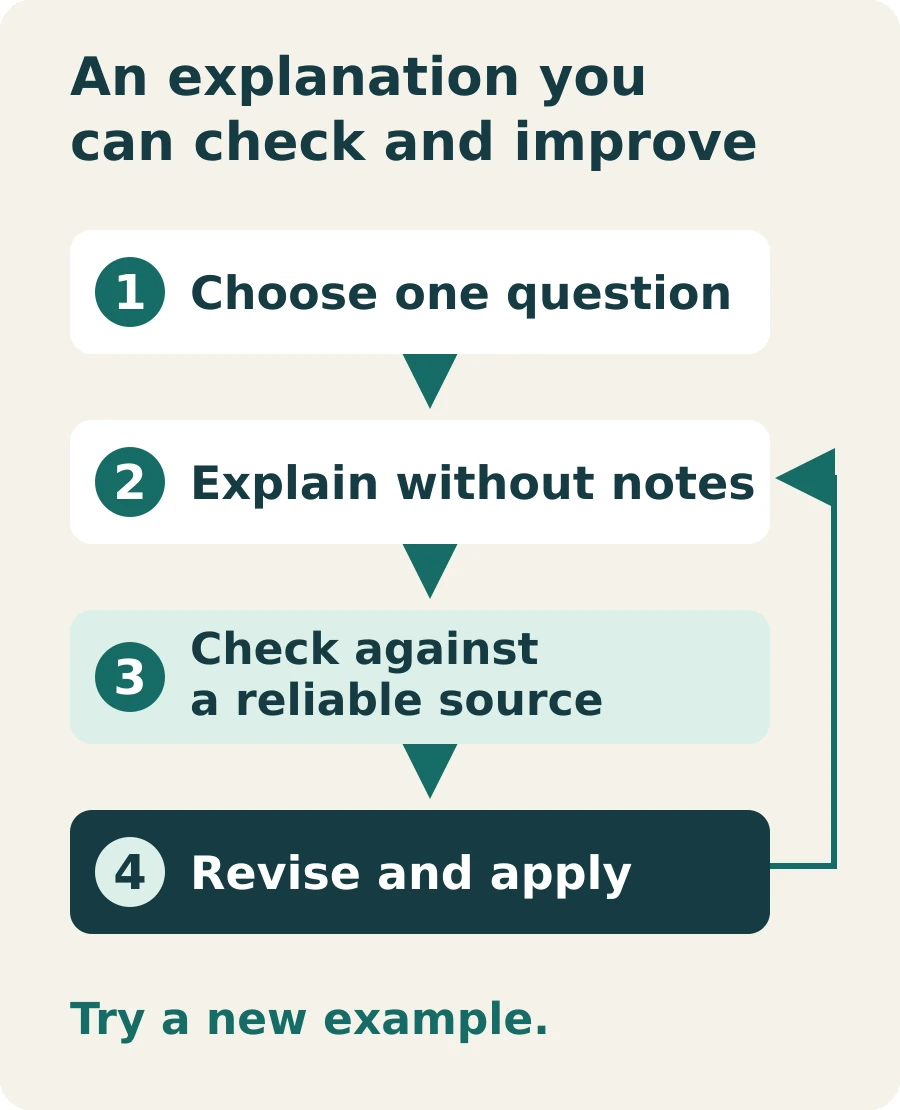
1. Choose one question you want to answer
Turn a broad topic into a manageable question. “Statistics” is too large. “Why can the mean and median tell different stories about the same numbers?” gives you a clear target.
Name the audience too: a classmate, a new colleague, or yourself next week. A beginner needs terms explained, but does not need important conditions removed. Write down the textbook section, official documentation, or approved procedure you will use to check your answer.
2. Explain it without looking at the source
Write a short explanation or speak it aloud and record the main points. Start with what the idea means, then explain how or why it works. Include a concrete example rather than relying only on a definition.
Keep useful technical terms and define them. Replacing “median” with “the middle thing” will not help if you forget that the values must be sorted first. The goal is to make the reasoning visible, not to remove every specialist word.
When you get stuck, mark the spot and continue. Do not immediately repair every sentence with a glance at your notes; you want a record of what you can currently explain.
3. Check the explanation and identify specific gaps
Compare your attempt with the reference, including the parts you felt sure about. Ask:
- Did I explain the cause or reasoning, or merely rename the result?
- Which terms did I use without understanding them?
- Did I leave out a condition, exception, or intermediate step?
- Does my example actually follow the rule?
- What would a beginner reasonably ask next?
Write a question for each important gap. “Review chapter three” is vague. “What happens to the median when there are an even number of values?” tells you exactly what to look up.
4. Revise, then try a new example
Check the missing points, correct errors, and put the source aside again. Produce a fresh explanation that includes the correction. Avoid copying the reference sentence and treating familiarity as understanding.
Then change something: use different numbers, explain a contrasting case, or predict what happens under a different condition. Check that answer too. If the new case exposes another gap, return to the relevant source or ask someone qualified to explain it.
Finish by recording what remains uncertain. A precise unanswered question is a useful outcome; forcing a tidy explanation can hide the very problem you need to solve.
Worked example: mean versus median
Suppose a learner wants to understand why an average can make a group of short tasks sound slower than most of them were. The figures below are invented for practice.
The first explanation
“The mean and median both show the typical time. You add everything and divide to get the mean. The median is the middle, so they should be about the same.”
This gets part of the calculation right, but leaves a claim unchecked: must the two results be similar? It also omits sorting and the even-number case.
Check it with numbers
Five tasks take 2, 3, 3, 4, and 18 minutes. Their total is 30 minutes. Dividing by five gives a mean of 6 minutes. The middle value in the sorted list is 3 minutes, the median.
The 18-minute task contributes to the total and pulls the mean above most of the individual times. Here, the median better represents the center of the ordered task times. That does not make the longer task irrelevant: it still matters to total workload.
The NIST explanation of measures of location provides the definitions and discusses how extreme values affect these measures.
The revised explanation
“The mean shares the total equally across all the observations. The median identifies the middle of the sorted values; with an even number, take the mean of the two middle values. An unusually large value can move the mean substantially while leaving the median unchanged. Which summary is useful depends on what we need to know.”
Test the revision
Replace 18 with 28. The total becomes 40, so the mean becomes 8 minutes. The median remains 3 minutes. Now try an even-number set: for 2, 3, 4, and 19, the median is 3.5, halfway between the two middle values.
The learner has done more than simplify a definition. They have corrected an assumption, handled an exception, and checked a fresh case. The completed worksheet follows this same example.
Workplace example: explaining website caching
Imagine a new colleague asks why a website can still show an old image after an update. This is a fictional learning scenario, not a diagnosis of a particular site.
A first answer might be: “The browser remembers the website. Clearing the cache fixes it.” That explanation sounds helpful, but makes an untested promise.
The gaps are concrete: Where might a saved copy exist? Does clearing one browser change what other visitors receive? Could the problem have another cause?
After checking MDN’s HTTP caching guide, the learner revises: “A cache stores a response so it can be reused. A browser may keep its own copy, and a shared cache, such as a content delivery network, may also hold one. Clearing my browser’s cache does not clear those shared copies. We need to identify which layer is involved before choosing a fix.”
For an application check, ask: “If a colleague on another computer still sees the old image, what would you investigate next?” A useful answer considers the site’s shared caching and publishing setup instead of repeating one universal fix. It also leaves room for a wrong image URL or an update that never published.
In a team learning session, use this pattern with an approved reference: explain a small process, invite one “why” or “what if” question, then verify the response. Keep the exercise separate from changing live systems or overriding the organization’s procedures.
What the research supports
The strongest reason to try this approach comes from research on self-explanation and learning by teaching. These studies test related learning activities, rather than establishing the popular four-step checklist as a formally validated protocol created by Richard Feynman.
In Chi and colleagues’ 1994 study, 14 eighth-grade students were prompted to explain a passage about the circulatory system as they read. Compared with 10 students who read the text twice, the prompted group showed larger gains on the knowledge assessment. This was a small study in a specific learning context, not evidence that any simple explanation guarantees understanding.
In Fiorella and Mayer’s 2013 experiments, students learned about the Doppler effect. On the one-week delayed test, the group that prepared and delivered a brief video lesson outperformed the normal-study control group; the preparation-only group did not significantly outperform that control. The result supports actually generating an explanation, rather than stopping at the intention to teach.
These findings give the routine a reasonable foundation. They do not promise a fixed improvement, make it the best method for every subject, or show that sounding fluent is a reliable test of accuracy. Checking and application remain essential parts of the practical approach here.
Feynman technique, active recall, and spaced repetition
These methods answer different questions and can work together:
| Method | Main question | Example |
|---|---|---|
| Feynman technique | Can I explain the idea and its reasoning? | Explain why an extreme value changes the mean. |
| Active recall | Can I retrieve what I learned? | State the mean and median rules without notes. |
| Spaced repetition | When will I return to the material? | Revisit the question in a later study session. |
Explaining without notes includes retrieval, but adds a focus on connections and reasoning. My active recall guide covers how to practice retrieving and checking answers. The spaced repetition guide helps you plan later reviews. Use this worksheet when the main problem is understanding what an answer means or why it works.
Common mistakes and limits
- Making it simpler until it becomes wrong. Keep conditions, units, and exceptions that affect the meaning. A useful analogy should come with a sentence about where it breaks down.
- Repeating a confident error. Check all essential claims, not only the ones that felt difficult. A listener’s agreement is not a substitute for a reliable reference.
- Using explanation instead of practice. Explaining a formula is different from solving an unfamiliar problem. Explaining a procedure is different from performing it safely. Include practice that matches the real goal.
- Choosing a topic that is too large. Work on one relationship or decision first. You can connect several small explanations later.
- Treating difficulty as a verdict on ability. A poor first explanation may reflect missing background knowledge, unfamiliar language, or an oversized question. Narrow the task and get help with the missing part.
For isolated facts, a short retrieval question may be enough. For complex or consequential work, use explanation alongside worked examples, feedback, supervised practice, and the required references. The worksheet is a learning aid, not a competence certificate.
Questions about the Feynman technique
Do I need to teach a real person?
No. You can write an explanation, speak to an imagined beginner, or record yourself. Another person can reveal questions you overlooked, but the important work is producing, checking, and improving the explanation. Choose a format you can use without turning the exercise into a presentation project.
Do I have to explain it to a child?
No. Use an audience that makes sense for your goal. Explaining a technical process to a new colleague is often more useful than stripping it down for a child. Preserve the knowledge the real task requires.
How long should a session take?
For one small question, try a short block such as 15 minutes, with time reserved for checking. That is a starting suggestion, not a research-established dose. If verification takes longer, finish it rather than stopping with a convincing but unchecked answer.
Download the free Feynman technique worksheet
The three-page download includes two reusable blank pages and a completed mean-versus-median example. Record your first explanation, list gaps, note the source you checked, write a revision, and test it with a new case. Use the PDF for printing or the editable Word file to adapt the prompts.
Use the free worksheet to capture your first explanation, check gaps, and test a better version.
Start with one question from something you are learning now. Write the first explanation before opening your notes. Then give the least clear sentence your attention: what, exactly, do you need to check?