
Active recall is a study method where you try to retrieve information from memory before looking at the answer. You might answer a question, explain a concept aloud, or redraw a diagram with your notes closed. Then you check your response and correct what you missed.
The method is simple enough to use with a textbook chapter, a professional course, or material from a training session. You need something to learn, a way to test yourself, and a reliable answer to check against.
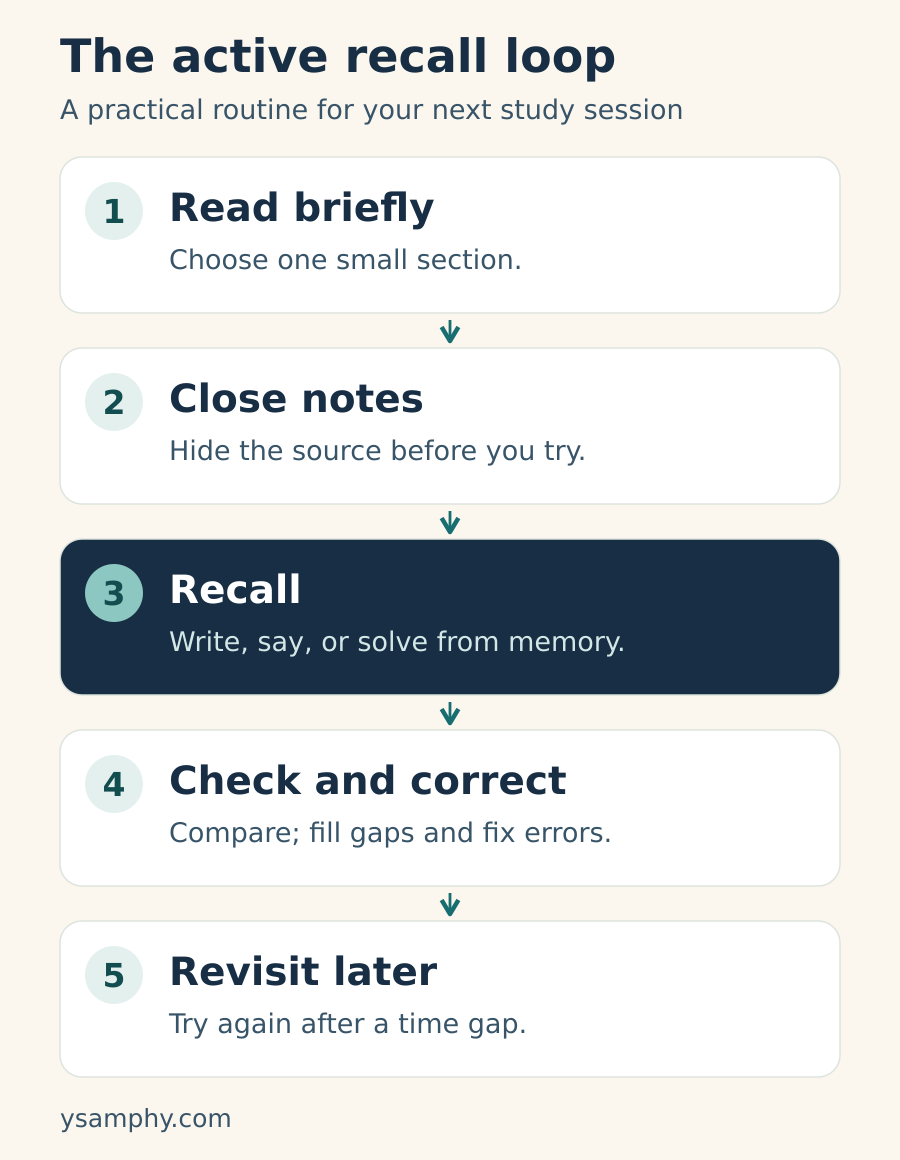
Start with this short sequence:
- Study a small section until it makes sense.
- Close or cover the source.
- Answer a few questions from memory.
- Check your answers and correct mistakes.
- Try the difficult questions again, then revisit them in a later session.
Below, we’ll work through the same water-cycle example from the first reading to the correction and retry. The free worksheet gives you space to use this process with your own material.
What is active recall in learning?
Active recall is commonly called retrieval practice in learning research. The important action is bringing something you previously learned back to mind.
For example, after reading about the water cycle, close the page and answer, “How is condensation different from evaporation?” You have to produce the explanation yourself before checking it.
Reading the explanation again can help you understand it. Recognizing it on the page, however, doesn’t tell you whether you can explain it without that support. A closed-book attempt makes that gap visible.
You don’t need a score, a timer, or a flashcard app. A few questions on paper are enough to begin. Keep the practice low stakes so you can use mistakes to decide what needs more attention.
Why active recall can help you remember
Retrieval practice can improve later retention. In Roediger and Karpicke’s 2006 experiments, students studied passages and either reread them or practiced recalling them. Repeated study helped more on a test given after five minutes. On tests two days or a week later, prior recall practice produced better retention.
That distinction matters when choosing how to study. Feeling fluent immediately after rereading is different from remembering the material days later.
The benefits can extend beyond recalling isolated facts. Karpicke and Blunt’s 2011 study found benefits on comprehension and inference questions about science texts, compared with the concept-mapping study condition used in their experiments.
These findings support including retrieval in your study routine. They don’t make every quiz equally useful or guarantee a particular grade. You still need accurate material, enough understanding to attempt the task, and practice that fits what you’re trying to learn.
How to use active recall step by step
1. Choose a small amount of material
Begin with one concept or short section. Trying to recall an entire unfamiliar chapter makes it harder to identify where you’re stuck.
For our example, read this paragraph:
Evaporation changes liquid water into water vapor. Condensation changes water vapor into liquid droplets, which can form clouds. Precipitation is water falling from clouds as rain, snow, sleet, or hail. Water collects in places such as rivers, lakes, and oceans, where some can evaporate again.
This is a simplified teaching model. The full water cycle includes other pathways and has no single starting point. See the USGS water-cycle overview for the broader picture.
Read to understand the changes taking place. If “water vapor” is unfamiliar, clarify that term before testing yourself.
2. Turn the important ideas into questions
Write prompts that require you to produce an answer. Include definitions and relationships, rather than testing only whether you recognize the vocabulary.
Use these four questions:
- What happens during evaporation?
- How is condensation different from evaporation?
- What is precipitation? Give two examples.
- After water collects in a lake, what process can return it to the atmosphere? Explain the change of state.
Question four checks whether you can use the concept in a situation. Your questions should reflect what you’ll eventually need to explain, decide, or do.
Keep the answer key separate from the questions. If you can see the explanation while answering, it becomes difficult to tell what you retrieved yourself.
3. Close the source and make an honest attempt
Write or say your answers before checking. Use your own words unless the subject requires exact terminology or wording.
Suppose your answer to question two is:
“Condensation is when water falls from clouds.”
Leave that answer visible. It will help you compare your first understanding with the correction. Don’t erase it and replace it with the key before noticing what went wrong.
If you draw a blank, make a brief attempt, then return to the explanation. You don’t need to spend the whole session struggling with something you haven’t understood yet.
4. Check against an accurate answer key
Here are the essential ideas for the four questions:
- Evaporation: Liquid water changes into water vapor, a gas.
- Condensation compared with evaporation: Condensation changes water vapor into liquid droplets. Evaporation changes liquid water into water vapor.
- Precipitation: Water falls from clouds. Examples include rain, snow, sleet, and hail; any two answer the question.
- Water returning from a lake to the atmosphere: Evaporation changes liquid water into water vapor.
Check meaning, completeness, and accuracy. “Liquid becomes gas” captures the main change in evaporation. “Water goes up” leaves the change of state unclear.
Our example answer to question two describes precipitation. The correction is: “Condensation changes water vapor into liquid droplets. Precipitation is water falling from clouds.” The USGS explanation of condensation clarifies the distinction.
5. Correct the specific gap and retry
Record what needs fixing: “I confused a change of state with water falling from clouds.” Then reread only the relevant explanation, cover it, and answer question two again.
A successful retry might be:
“Condensation changes gas into liquid droplets. Evaporation changes liquid into gas.”
Feedback deserves a place in the routine. In a 2008 study by Butler and Roediger, feedback after multiple-choice questions improved later correct recall and reduced the persistence of incorrect answer choices compared with no feedback.
For self-study, the practical lesson is to check what you retrieve rather than assume an answer is right because it came to mind confidently.
6. Return to the questions later
The immediate retry checks whether you can now produce the correction. A later attempt checks what you can still retrieve after time has passed.
At your next review, answer all four questions with the source closed. Give extra attention to the condensation question, but check the other ideas too. A correct answer today doesn’t establish permanent mastery.
Active recall methods you can use
Choose a format that suits the material and the task you need to perform.
Question and answer practice. Use the four water-cycle prompts above. This is a straightforward choice when you need to explain specific ideas.
Flashcards. Put “What happens during evaporation?” on the front and the essential answer on the back. Produce your answer before turning the card over. Keep each card focused enough to judge your response clearly.
A blank-page explanation. Close the source and write what you remember about the water cycle. Then compare it with the paragraph. Look for missing relationships as well as missing terms.
A diagram from memory. Draw water collecting in a lake, evaporation, condensation, and precipitation. Label the changes before checking a reference. Copying the finished diagram is a different activity.
An explanation aloud. Explain why condensation and evaporation involve opposite changes of state. Record yourself or write a few checking points so you can verify the explanation afterward.
You can combine formats. There’s no need to build an elaborate system before you try your first recall attempt.
Active recall and spaced repetition
Active recall describes what you do: retrieve information from memory. Spaced repetition describes when you revisit it: across separate study sessions.
You can use both by answering the water-cycle questions today and returning to them later. You can also space out rereading, so spacing alone doesn’t tell you whether you practiced retrieval.
There is no single review schedule that fits every subject and deadline. Cepeda and colleagues’ 2008 research found that the most effective gap between learning sessions depended on how far away the final test was.
As a practical starting point, choose your next review before ending the current session. If an idea still needs help, revisit it sooner. If you can explain it accurately across separate sessions, try a longer gap. Adjust to your deadline and performance; a fixed “day 1, day 3, day 7” sequence is an option to test, not a universal rule.
Common mistakes and how to fix them
Looking at the answer too soon. Cover the key and commit to an answer first. A short written response makes it harder to confuse recognition with recall.
Testing material you don’t yet understand. Read an explanation or work through an example, then try a smaller question. If condensation is confusing, start with the change from gas to liquid before explaining the whole cycle.
Counting a partly correct answer as complete. Check the essential ideas. Question three needs a definition and two examples. Naming rain alone leaves part of the question unanswered.
Leaving errors uncorrected. Write the correct explanation, identify what you confused, and retry with the key hidden. Keep the original error available for comparison.
Practicing only easy facts. Once you can define evaporation, answer the lake question and explain the change of state. Match the depth of your practice to what you need to understand.
Spending all your time making study materials. Start with a handful of useful questions. Add more when they serve a clear learning need.
Using active recall in workplace learning
The same structure can support a training session. After explaining a concept, give learners time to retrieve the key ideas individually, then compare answers with an accurate reference and discuss gaps.
Keep recall connected to the work. Remembering a procedure’s steps is useful, but employees may also need to perform the procedure and handle exceptions. For a broader approach to workplace learning, see how to build practical AI training for employees.
Retrieval can be one part of focused skill practice. When the goal is better performance, combine it with relevant tasks and feedback, as discussed in this guide to Anders Ericsson’s deliberate practice.
Questions about active recall
Is active recall better than rereading?
For later retention, retrieval practice has outperformed repeated reading in controlled studies such as the 2006 experiments above. Rereading still has a role when you’re first understanding something or correcting an error. Include time to attempt recall instead of using familiarity as your only progress check.
Can I use active recall without flashcards?
Yes. Answer questions on paper, explain a concept aloud, draw a diagram from memory, or work through a suitable practice problem. Check your response against a trustworthy reference or worked solution.
What if I remember almost nothing?
Reduce the amount of material and return to the explanation. Clarify unfamiliar terms, study one small part, and try again. A blank response is information about what needs attention; it isn’t a reason to keep guessing indefinitely.
How long should an active recall session last?
Long enough to attempt a manageable set of questions and check your answers. Choose the amount of material around the time you have. Leave room for corrections and a retry, rather than spending the entire session producing answers you never review.
Use the free active recall worksheet
The printable worksheet includes reusable pages for your source, questions, first answers, corrections, retry, and next review. It also includes the completed water-cycle example and answer key so you can see how the process works.
For your next study session, choose one small section and write four questions. Close the source, answer them, and check what needs fixing. Use those results to decide what to practice next.



