
Spaced repetition is a learning method that spreads reviews of the same material across separate sessions. You return after a gap, check what you can remember, and decide when to review it again. The aim is to keep useful knowledge available beyond the day you first learn it.
The practical challenge is keeping track. What should you review tomorrow? Which topic needs another attempt sooner? What happens when you miss a session?
This guide gives you a flexible schedule, a worked example with three workplace-learning topics, and a free four-week planner you can print or edit.
A simple way to begin
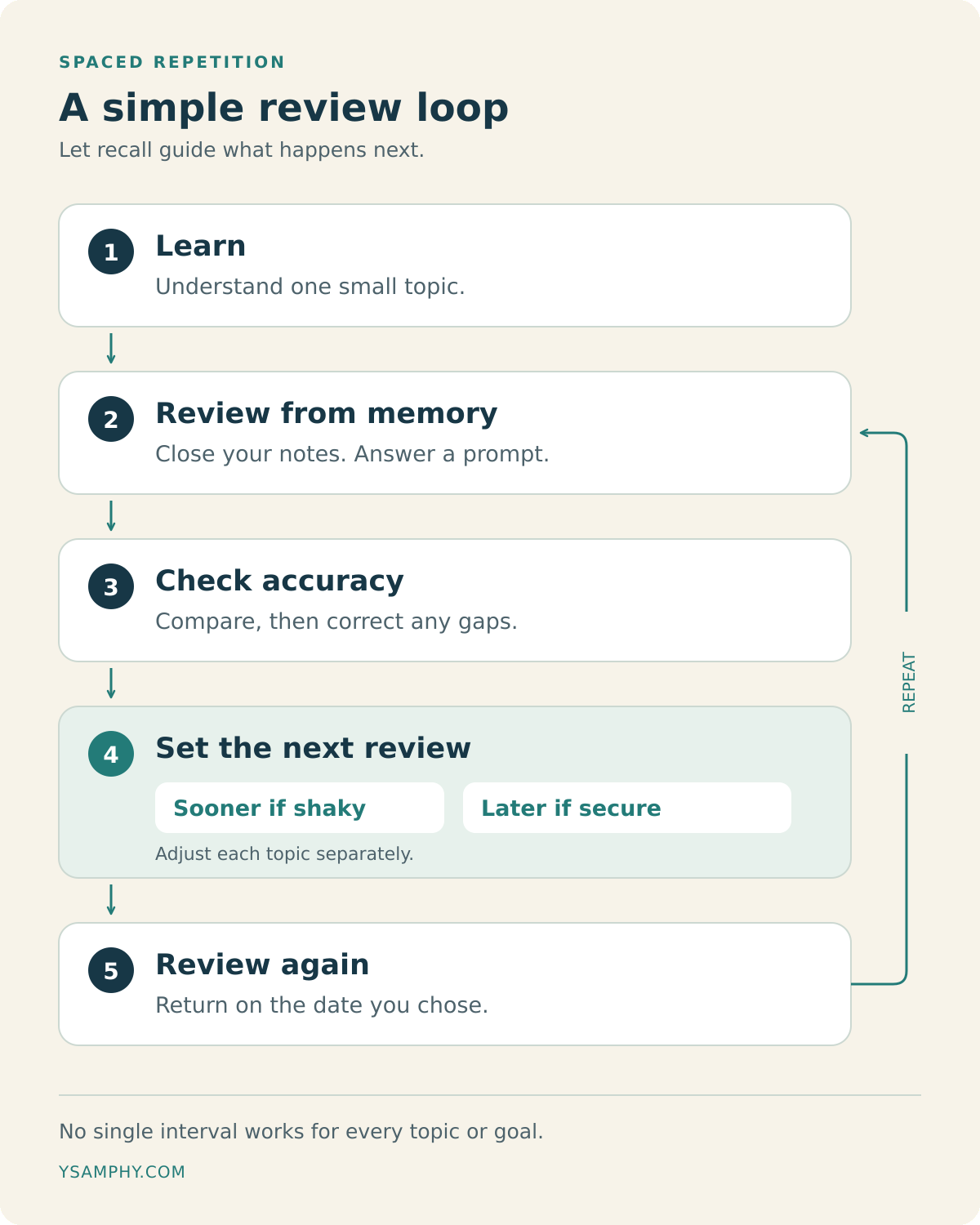
Choose a small set of material. Schedule the first review. Try to recall it before checking your notes. Record the result and choose the next date. Adjust each topic separately as you learn what needs attention.
Plan four weeks of reviews, record what you remember, and adjust your next dates with the free review schedule.
What is spaced repetition?
Spaced repetition means revisiting previously learned material over time. For example, you might learn a procedure on Monday, review it on Tuesday, and return later that week. The gaps give you opportunities to check what remains available after the initial lesson.
The related term distributed practice describes spreading practice over time. Spaced repetition usually refers to repeated reviews of particular knowledge, often using questions, flashcards, or short exercises.
You can space out several kinds of practice. In this guide, reviews include retrieval: trying to produce an answer before looking at the source.
Active recall describes the retrieval activity; spaced repetition describes its timing. If you need help writing questions, checking answers, or correcting errors, start with my active recall guide. Here, we’ll focus on managing the reviews that follow.
Why spacing helps, and why timing needs flexibility
Research supports distributing learning across sessions. A 2006 meta-analysis by Cepeda and colleagues examined 317 experiments on verbal recall. It found that the useful gap between study sessions depended partly on how long people needed to retain the information.
In Cepeda and colleagues’ 2008 study, more than 1,350 participants learned facts and returned for a review and a later test. Longer gaps initially improved final performance, but stretching them further eventually reduced it. The best-performing gap grew as the delay to the final test increased.
The practical implication is to consider your goal. Preparing for an assessment next week and maintaining knowledge for next year call for different planning. This research does not establish a universal “1, 3, 7, 14, 28” calendar.
The activity during each review matters too. Roediger and Karpicke’s 2006 experiments found that recalling studied passages improved retention on delayed tests compared with repeated reading, although repeated reading performed better on an immediate test.
Use these findings to make room for spaced retrieval. The calendar and adjustment rules below are practical planning suggestions, not a tested prescription for every learner or subject.
How to use spaced repetition
1. Decide what you need to remember and when
Write a concrete goal: “Explain the three checks before sharing an AI-generated summary at next month’s team practice session.” Include a target date if you have one.
Choose knowledge worth keeping available. A recurring procedure, core concepts from a course, or vocabulary you use regularly may deserve reviews. A detail you can easily look up once may not need a place in the schedule.
2. Keep the review small enough to finish
Create a few prompts for one topic. Give each topic a clear name and keep a reliable answer key or approved reference nearby. Start with material you have already worked to understand.
For a procedure, include a question about when to use it or how to handle an exception. If the goal is performing a task, include a realistic practice task alongside memory questions.
3. Put the first review on your calendar
Choose an achievable date, such as the following day for a new topic, and reserve enough time to answer, check, and correct. A ten-minute block can be a starting experiment for a small set of questions; more demanding work needs longer.
A calendar reminder should identify the material: “Review data-handling questions 1–4” is easier to act on than “Study.” Keep the questions and reference linked or stored together.
4. Record what happened before choosing the next date
Attempt the questions with the answers hidden, then compare your response with the reference. Use a simple record:
- C: Correct. You retrieved the essential points without notes.
- P: Partial. You retrieved some points but missed or confused something important.
- I: Incorrect or blank. The answer needs correction or the material needs more explanation.
Record specific gaps, such as “missed the disposal step.” Feeling confident is not enough to mark an answer correct. If questions within a topic have different results, separate the difficult ones rather than averaging the whole topic into a pass.
5. Adjust the next review
- Correct across separate sessions: consider a longer gap, within your deadline.
- Correct but uncertain or effortful: keeping a similar gap may be sensible while you check consistency.
- Partial, incorrect, or blank: correct the gap and try again, then schedule an earlier follow-up. The next day is one possible choice.
These are decisions, not automatic scores. Repeated difficulty may mean the prompt is too broad, the explanation is unclear, or you need a worked example. Adding more reminders will not solve every learning problem.
A four-week spaced repetition schedule you can adjust
Here is one starting pattern for a small amount of newly learned material. Day 0 is the initial learning date. Every later day number is counted from Day 0, rather than from the previous review.
| Elapsed day | Example date | Plan |
|---|---|---|
| Day 0 | 19 October 2026 | Learn the material and prepare questions |
| Day 1 | 20 October | First review; check gaps |
| Day 3 | 22 October | Review and adjust each topic |
| Day 7 | 26 October | Check what remains after a longer gap |
| Day 14 | 2 November | Review and include an application question |
| Day 28 | 16 November | Check retention and plan beyond four weeks |
The gaps between these reviews are 1, 2, 4, 7, and 14 days. The planner covers the four weeks after initial learning, ending on Day 28. Treat later dates as provisional: a weak response can bring a review forward, while reliable performance may support a longer gap.
No magic sequence
Increasing intervals are convenient for planning, but they are not always superior. In a 2011 experiment by Karpicke and Bauernschmidt, spacing repeated retrieval improved later retention, while expanding, equal, and contracting schedules did not differ reliably under the tested conditions. Focus on returning over time and checking your results.
If an assessment is sooner, build a shorter plan with opportunities to correct gaps before it. If the knowledge needs to last for months, continue reviewing beyond this worksheet. Four weeks is a planning window, not a completion certificate.
How to manage several topics: a worked example
Imagine an employee completing a short workplace AI course on 19 October. This is a fictional planning example, not a reported training result.
The employee prepares questions for three topics:
- AI output checks: What must be verified before using a generated summary?
- Data-handling rules: Which rules apply to preparing, using, and disposing of the practice material?
- Escalation steps: When should work stop, and who should be asked for help?
The answers come from the organization’s current, approved guidance. The schedule does not supply or override that guidance. For the wider program design, see AI training for employees.
The first review changes one topic’s schedule
On 20 October, the employee recalls the AI checks and escalation steps correctly. Those topics stay scheduled for 22 October. The data-handling answer misses a disposal step, so the employee records P, checks the reference, and practices the correction.
Only that topic gets an extra review on 21 October. A correct response then leads to another check on 22 October. The other two topics do not need to restart because one topic was difficult.
Later reviews follow the actual results
All three topics are recalled correctly on 22 October, so the next planned review is 26 October. AI checks and data rules are completed that day. The escalation review is missed and moved to 27 October.
The missed entry says “not attempted.” It is not scored as an incorrect answer. After an accurate attempt on 27 October, the employee chooses 2 November for the next review, alongside the other topics.
On 2 and 16 November, accurate responses support continuing the plan. The completed worksheet shows another review on 30 November, beyond the four-week window. These choices illustrate adjustment; they do not predict how another learner will perform.
Keep one review list
Give each topic one current next-review date. Each day, check what is due; after reviewing, replace that date with the next one. Keep the completed log as a record, rather than creating several competing reminders for the same material.
Start with a small queue. If reviews repeatedly exceed the time available, pause new additions, narrow oversized topics, and prioritize knowledge connected to a near deadline or important task. Familiar, lower-priority topics can move later after you check them.
What to do when you miss a review
Resume with a short check of the material you missed. Record the date you actually reviewed it, the result, and a realistic next date. You do not need to restart every topic at Day 1.
If several reviews have piled up:
- Identify the most urgent or consequential material.
- Complete a manageable batch and check the answers.
- Schedule sooner follow-ups for the gaps you find.
- Move the remaining reviews to dates you can actually keep.
Avoid squeezing every missed session into one sitting just to clear the calendar. An overdue date tells you a review did not happen; today’s attempt tells you what you can remember.
If you are consistently missing the same block, change the routine. Reduce the amount, choose a quieter time, or attach the review to an existing study session. Keep time for checking and correction.
Questions about spaced repetition
Can I use spaced repetition without an app?
Yes. Paper questions, a calendar, and a review log are enough. Flashcard software can manage a larger collection, but you still need useful prompts, accurate answers, and honest ratings. Choose a tool you will use consistently.
Should I review every topic every day?
Use daily time to work through what is due, if that suits your schedule. Each topic can have its own review date. If everything remains due every day, check whether the sets are too large or whether correctly recalled material can move to a longer gap.
Does remembering the answers mean I can do the work?
Not necessarily. Add practice that resembles the real task: review a new sample, explain a decision, or perform the procedure under appropriate supervision. Keep required checklists, references, and approvals in place for consequential work.
Download the free review schedule
The four-page planner includes a blank four-week overview, a reusable review log, a dated fictional plan, and a completed log showing both a weak response and a missed review. Use the PDF for printing or the editable Word version to adapt the fields.
Plan four weeks of reviews, record what you remember, and adjust your next dates with the free review schedule.
Choose one topic you want to retain, write its first review date, and leave the later dates open to revision. After that review, record what you could retrieve and decide when to return.



