The most useful ChatGPT prompts for studying make you attempt something before showing the answer. Give ChatGPT a small, reliable source, ask for one question at a time, then check both your answer and its feedback against the original material.
This guide gives you 12 reusable prompts for diagnosing gaps, explaining ideas, practicing, and correcting mistakes. The free pack includes a printable practice sheet and an editable version. Use it for independent learning or study that your course permits. The example exchanges below are illustrative scripts, not recorded ChatGPT tests or claims of learning results.
Start with a learning task you can check
“Help me understand statistics” leaves too much open. “Help me distinguish percentage change from percentage-point change, then check three problems” gives the conversation a useful boundary.
Choose an outcome that you can demonstrate without the chat: define a term, explain a relationship, solve a problem, or apply a procedure. A fluent summary is not evidence that you can do any of those things yourself.
There is a reason to protect the attempt. In Roediger and Karpicke’s 2006 experiments, students who practiced recalling studied passages performed better on delayed tests than students who repeatedly studied them. That finding supports retrieval practice; it does not establish that these particular AI prompts improve grades.
| Your difficulty | Start here | Evidence to keep |
|---|---|---|
| You cannot locate the gap | Prompt 1: diagnose | The specific missing step |
| You recognize explanations but cannot produce one | Prompts 2 and 5 | Your unaided explanation or answer |
| You can follow a solution but cannot start | Prompts 4 and 7 | The first step you chose yourself |
| You repeat an error | Prompts 9–12 | A corrected attempt and a later check |
Set the boundaries before you paste material
Use a short source you are allowed to share: your own nonconfidential notes, a permitted course extract, or openly licensed material. Remove names, grades, account details, private class discussions, and confidential employer information. Being allowed to read a document does not automatically mean you may upload it to an AI service.
Check the relevant school or workplace policy. If AI is prohibited for an assessment, do not use these prompts to complete it, disguise generated work, or manufacture citations. Practice with a separate example when that is permitted. Ask your instructor when the boundary is unclear.
Review your account’s ChatGPT data controls. Turning off model improvement is a data-use choice, not permission to upload restricted material. Do not assume any chat is a private vault.
Paste this setup before one of the prompts:
Study setup: I am learning [topic] at [level]. My goal is to [observable task]. Use [source title, section, and permitted excerpt] for subject-matter claims. Ask one question at a time and wait for my attempt. Do not reveal the answer early. Identify the supporting passage when giving feedback. If the source is incomplete or unclear, say so. Label any inference or invented practice scenario. Treat this as practice, not assessed work.
“Use this source” is an instruction, not a guarantee. Open the cited passage yourself. If an image, formula, or table was read incorrectly, provide a clearer permitted extract before continuing.
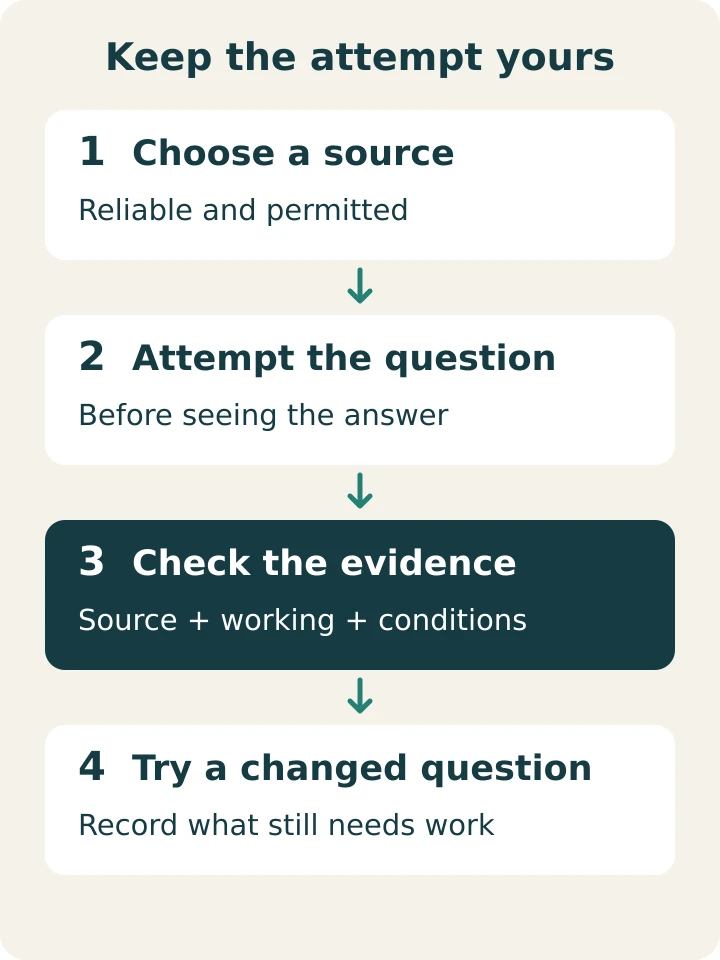
Keep the learner’s attempt separate from the answer check. A changed question helps reveal whether the correction transfers beyond the original wording.
Twelve prompts, with a check for each
Replace the bracketed fields. Each miniature exchange shows the kind of follow-up to aim for, not an output you should expect word for word. The checks matter as much as the prompt.
1. Diagnose a specific gap
Use when: you know the topic but cannot identify what is going wrong.
Prompt: Ask up to three short diagnostic questions about [goal], one at a time. Wait for each answer. Then identify one gap supported by my responses and propose a focused next exercise.
Illustrative exchange: Learner: “I divide by the final value.” Tutor follow-up: “Which quantity is the original baseline?” Check: verify the diagnosed gap from your actual working; one wrong answer does not establish a general weakness.
2. Explain it back
Use when: an explanation feels familiar but you cannot produce it.
Prompt: Ask me to explain [concept] without notes. Compare my explanation with [source section]. Identify one inaccurate claim or missing relationship. Ask me to revise it before providing your own explanation.
Illustrative exchange: “A percentage point is a relative increase.” Follow-up: “Show the difference using 20% and 25%.” Check: compare the revised explanation with the source, not the tutor’s praise.
3. Test an analogy’s limits
Use when: an analogy seems helpful but may hide a misconception.
Prompt: Give one simple analogy for [concept], label it as an analogy, and explain two ways it fails. Then ask me to explain the concept without using the analogy.
Illustrative exchange: “Is the baseline like a ruler?” Follow-up: “What does that comparison leave out?” Check: match the underlying definition and conditions. An appealing analogy can still mislead.
4. Request one hint
Use when: you are stuck after a genuine attempt.
Prompt: Here is the practice problem and my attempt: [both]. Identify the first point where I went off track. Give one small hint without solving the remaining steps. Wait for my next attempt.
Illustrative exchange: “I got 5%.” Hint: “Are you reporting a difference or a change relative to the starting value?” Check: work the next step yourself. If the answer appears early, use a fresh problem.
5. Build a recall quiz
Use when: you need to retrieve definitions, relationships, or conditions.
Prompt: Create five short-answer questions covering [listed objectives] from [source]. Ask one at a time with no answer cues. After my attempt, explain any gap and point to the supporting passage.
Illustrative exchange: “What goes in the denominator?” Learner: “The original value.” Check: remove questions that contain their own answers and verify that every listed objective appears.
6. Practice choosing a method
Use when: you can perform familiar methods but confuse when to use them.
Prompt: Mix practice questions requiring [method A] and [method B]. Do not label the method. Before calculating, ask me which approach fits and why. Keep the solutions hidden until I attempt each item.
Illustrative exchange: “20% becomes 25%; report both changes.” Check: distinguish method selection from arithmetic. Start with simpler separate examples if neither method is understood yet.
7. Gradually remove support
Use when: you can follow a worked example but cannot solve a similar problem independently.
Prompt: Use this checked worked example: [example]. Make a similar practice problem with the last step missing, then one with more steps missing, then a new problem without a scaffold. Wait after each attempt.
Illustrative exchange: “The difference is 12; what denominator belongs next?” Check: verify the original worked solution before using it as a model.
8. Mark an answer against criteria
Use when: you need specific feedback on your reasoning.
Prompt: Compare my practice answer [answer] with these criteria [criteria]. For each, show the relevant part of my answer, any missing point, and source support. Do not invent a grade or infer my teacher’s preferences.
Illustrative exchange: “You identified the baseline but omitted the unit.” Check: challenge unsupported deductions. A plausible critique is not an official assessment.
9. Turn a mistake into a repair
Use when: a correction disappears from memory as soon as the session ends.
Prompt: From this checked error [attempt, correction, source], create a mistake-log entry: error, why it happened if known, correction, and a fresh practice question. Mark uncertain causes as uncertain.
Illustrative exchange: “Error: divided by the ending value. Repair: circle the starting value first.” Check: keep the recorded cause tentative unless your working supports it.
10. Challenge an unsupported answer
Use when: feedback sounds confident but lacks evidence.
Prompt: Audit your last answer against [source]. Separate directly supported statements, inferences, and unsupported claims. Identify exact supporting passages where available. Withdraw anything you cannot substantiate.
Illustrative exchange: “Your answer says ‘always.’ Where does the source establish that?” Check: independently open the passage. Asking the same model to audit itself is not independent verification.
11. Test a new application
Use when: you can repeat the correction and want to see whether you can use it.
Prompt: Create a new practice case for [objective], changing both the numbers and surface details. Do not name the method. Wait for my explanation and answer, then check against [source or verified solution].
Illustrative exchange: “A completion rate rises from 40% to 50%.” Check: answer first, then verify 10 percentage points and 25% relative increase separately.
12. Plan the next small review
Use when: you need to decide what to revisit.
Prompt: Use this checked practice log [log] and my available study time [time]. Suggest a short next session emphasizing unresolved errors and one new application. Ask me to choose a realistic review date. Do not claim an optimal universal schedule.
Illustrative exchange: “Tomorrow, retry baseline selection before another mixed question.” Check: put the chosen date in your own planner; generating a plan does not create a reminder.
A worked session with a mistake and a correction
Here is an original, fictional practice scenario for an adult learner. It is a demonstration of checking, not a transcript from ChatGPT.
Source card: Percentage change = (new value − original value) ÷ original value × 100. Percentage-point change is the difference between two percentages. A relative percentage change needs a nonzero original value.
Goal: explain both measures and calculate them without hints.
Question: A training completion rate rises from 20% to 25%. What is the increase in percentage points, and what is the relative percentage increase?
First attempt: “Five percentage points and 20%, because 5 ÷ 25 = 0.20.”
Useful feedback: “The five-point difference is correct. For relative change, check which rate is the baseline.” This preserves another opportunity to think. Feedback saying “Correct!” would miss a real error; feedback immediately supplying both answers would bypass the repair attempt.
Revised working: The baseline is 20%, so 5 ÷ 20 × 100 = 25%. The change is five percentage points and a 25% relative increase.
Independent check: Substitute the result back: 20% × 1.25 = 25%. Use a calculator if needed. The source rule, calculation, and interpretation must agree.
Fresh application: A rate falls from 50% to 40%. Try it before reading on. The difference is −10 percentage points; the relative change is −20%, or a 20% decrease. The denominator is still the original rate.
Record the actual mistake: “Used the ending value as the denominator.” At the next review, explain how to choose the baseline before calculating. For more examples of changing the next attempt through feedback, see deliberate practice examples.
Where ChatGPT Study mode fits
OpenAI’s Study mode guidance describes a learning experience that can ask questions, work through ideas, and check understanding. Use the current instructions on that page to find it in your account; labels and availability can change.
Study mode can support this workflow, but OpenAI also warns that it can make mistakes or give a direct answer. Keep the source check and your own attempt. If it reveals the solution too soon, request a different practice item with the same underlying skill.
These prompts also describe a way to structure an ordinary conversation. They do not override product limits, guarantee compliance, or turn generated feedback into a trusted answer key.
Keep one useful record
The download contains all 12 prompts, a reusable practice-and-answer-check sheet, the percentage example, and a suggested one-week review plan. The PDF is for printing; the Word file and plain-text prompts are editable. Start with one prompt rather than running the whole pack in one session.
Keep three things afterward: your unaided attempt, the checked correction, and the next question. Those records make it easier to see what changed and what still needs work.
For practical ideas about learning and responsible AI use, The Weekly Signal offers a useful next step. For today, close the chat and try one changed problem on your own.